
2026 Roaring Canyons Semester #3
In every past recount of our journey, I have made a nod to the fact that this is merely the beginning. And yet now, seemingly before one could blink, it is far closer to the end. The river of time never ceases, pulling us steadily into a place of liminal spaces where beginnings and endings overlap.
 Currently we stand on the precipice of our final expedition, a culmination of adventures had, lessons learned, and stories told over the course of the past several weeks. However, before we can begin, I must remember and recount the way our river has swirled, twisted and changed since I last bid you farewell.
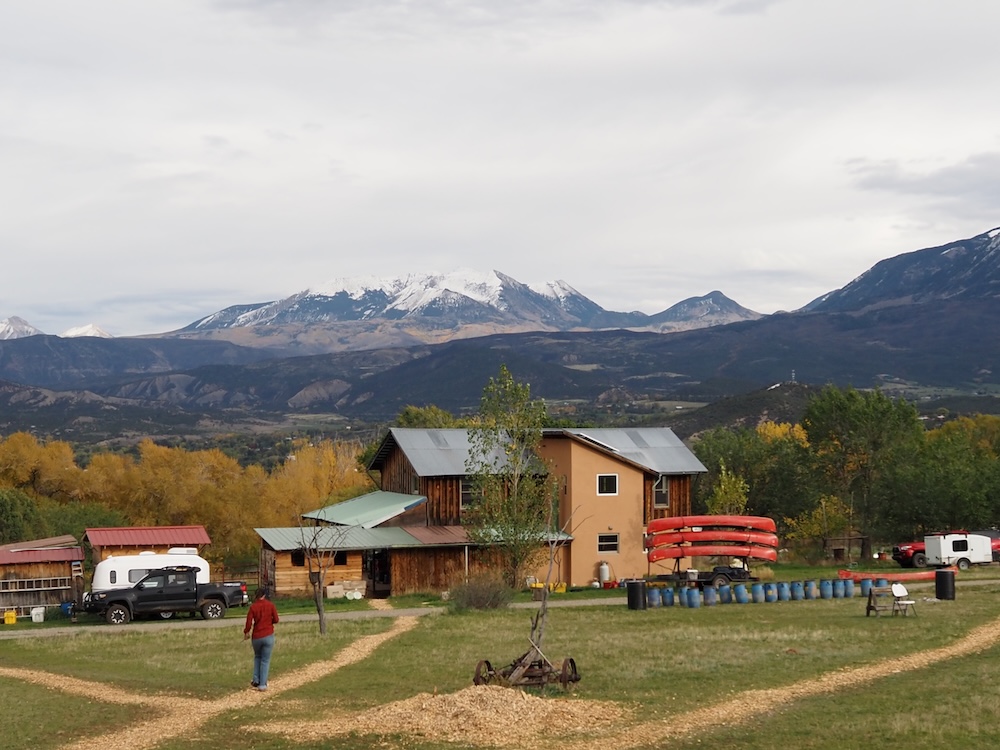
Dev’s home in Paonia, CO–The High Desert Center
 Following the river upstream along the route we have already traveled, I now bring us to a quiet haven of kindness and learning surrounded by towering mountains in Paonia, Colorado. We arrived at High Desert Center after our muddy trek up Mineral Bottom, to a hot meal and kind welcome from Dev. Buildings made from any and all scrap materials dot the hillside, built from hand tools and creativity. We spent a week here, learning skills that many of us will use for the rest of our lives.
 On our third day, we were handed a set of instructions, a blindfold, and one ground rule: don’t get arrested. We then covered our eyes, held hands in a line, and made our way to an unknown vehicle at an unknown location on Dev’s property. The engine took several tries to start, but eventually we were driven down the hill to Paonia and dropped off in different locations in groups of three, approximately a mile from downtown where we were to meet in a couple of hours.
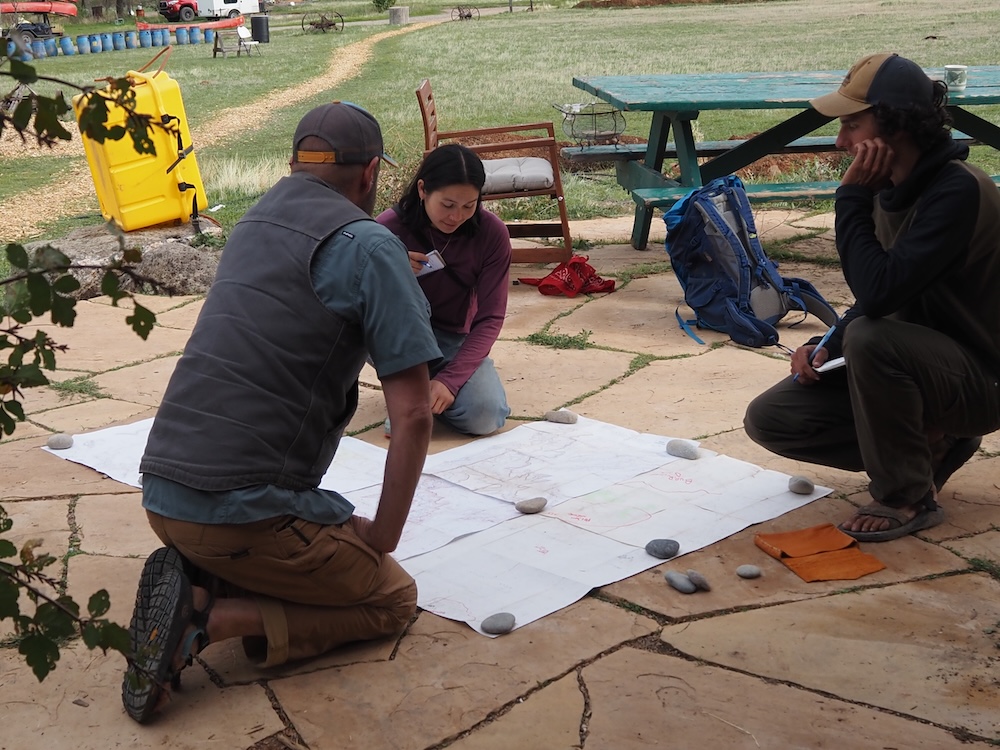
Dave, Gracie and Keane mapping and planning the upcoming expedition
This exercise contained two main parts, and the first is a challenge: Once the bus has sputtered away, remove your blindfold and find your way a mile back to town without being spotted by innocent civilians. I accidentally removed my blindfold a moment too early and am completely unsurprised to find the bus is brightly painted with hand drawn murals and appears as though it recently chugged its way out of the 60s. My group of three has been left in a graveyard, where we promptly ate our snack of old trail mix and then begin plodding our way down the road in the direction we hope is town. We made it about three hundred yards before the low thrum of a car engine reverberated in the distance, and we dove enthusiastically into a ditch. This continued for an hour or so, during which we meet an elderly lady wondering if we needed help and a guy in a car which we ran away from at top speed. Finally, after much running, hiding, and awkward encounters, we found our way to a small park in downtown Paonia where Dave and Dev are waiting for us.
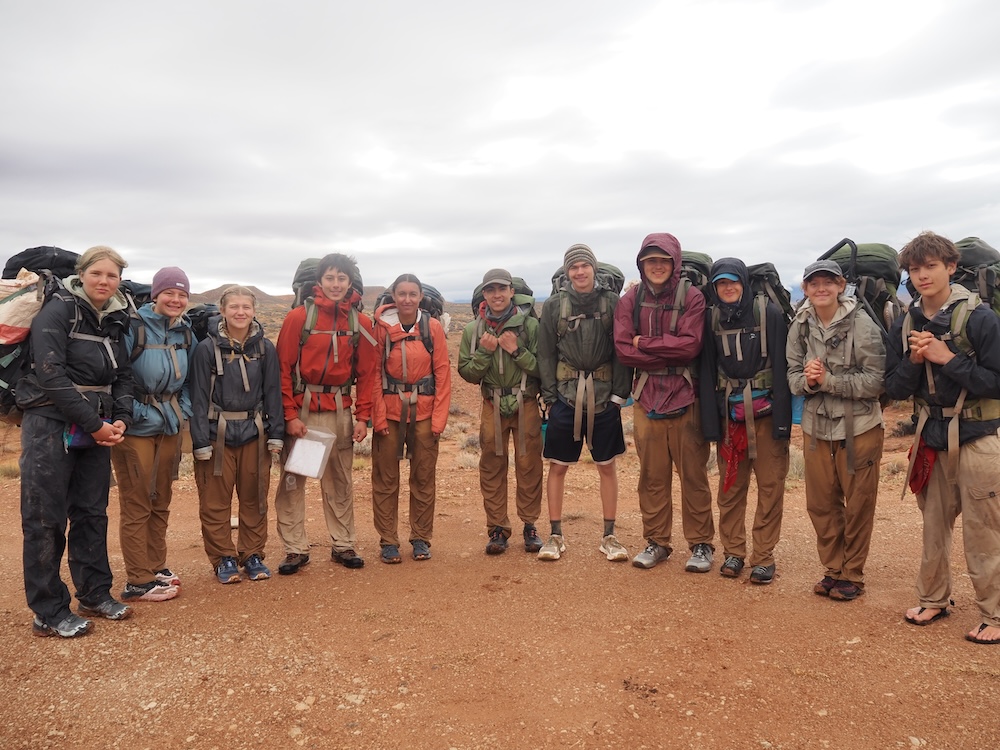
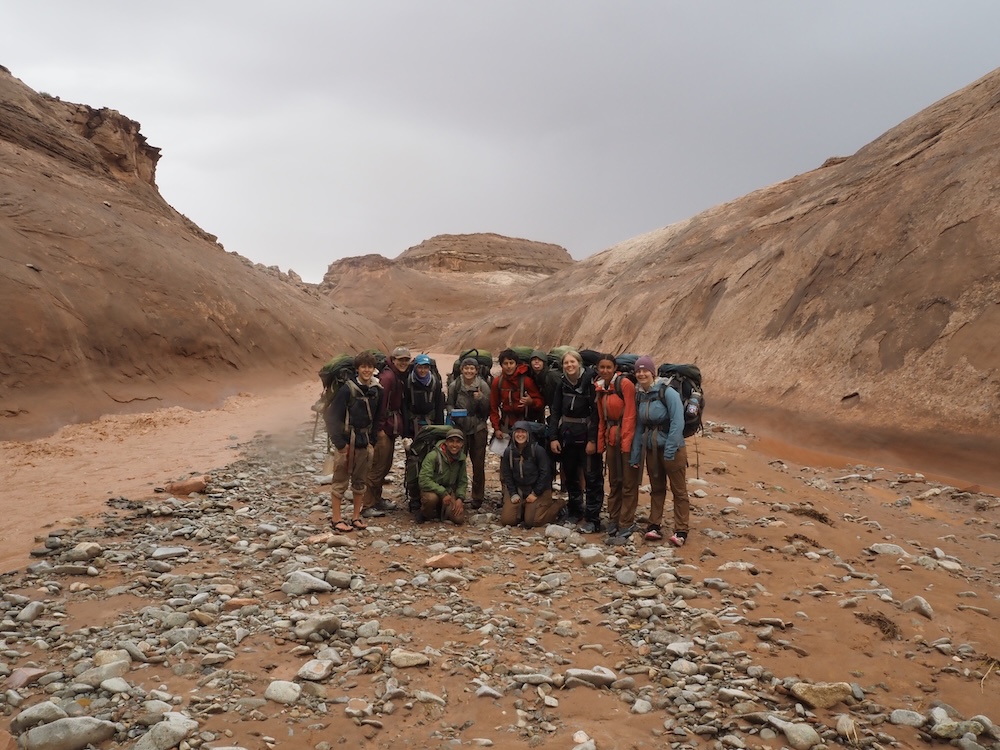
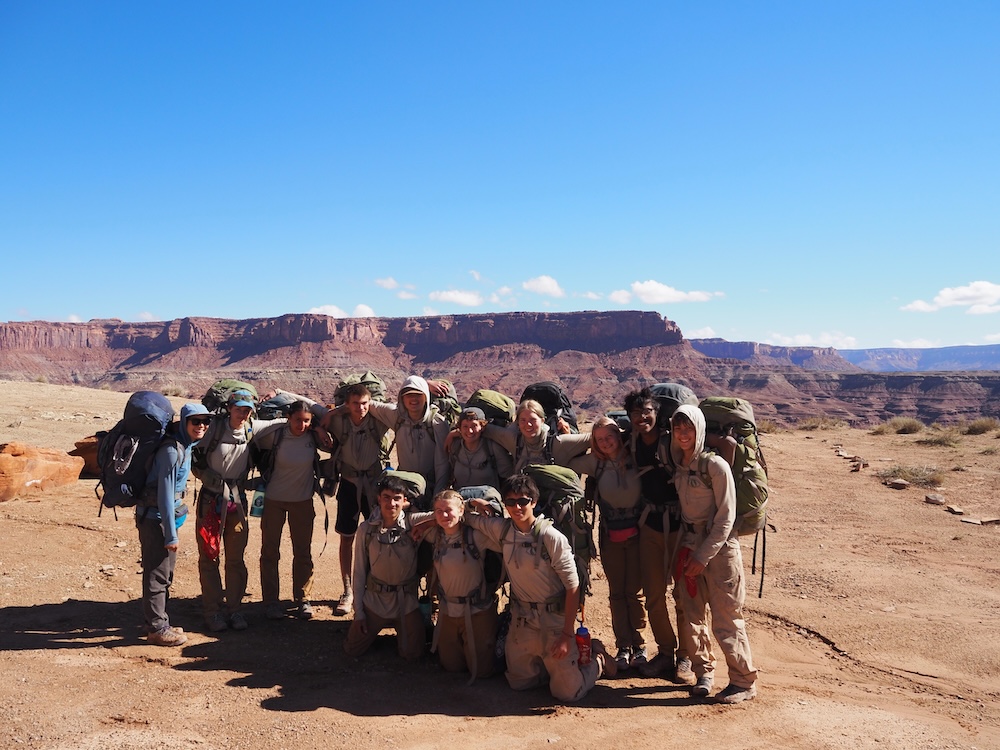
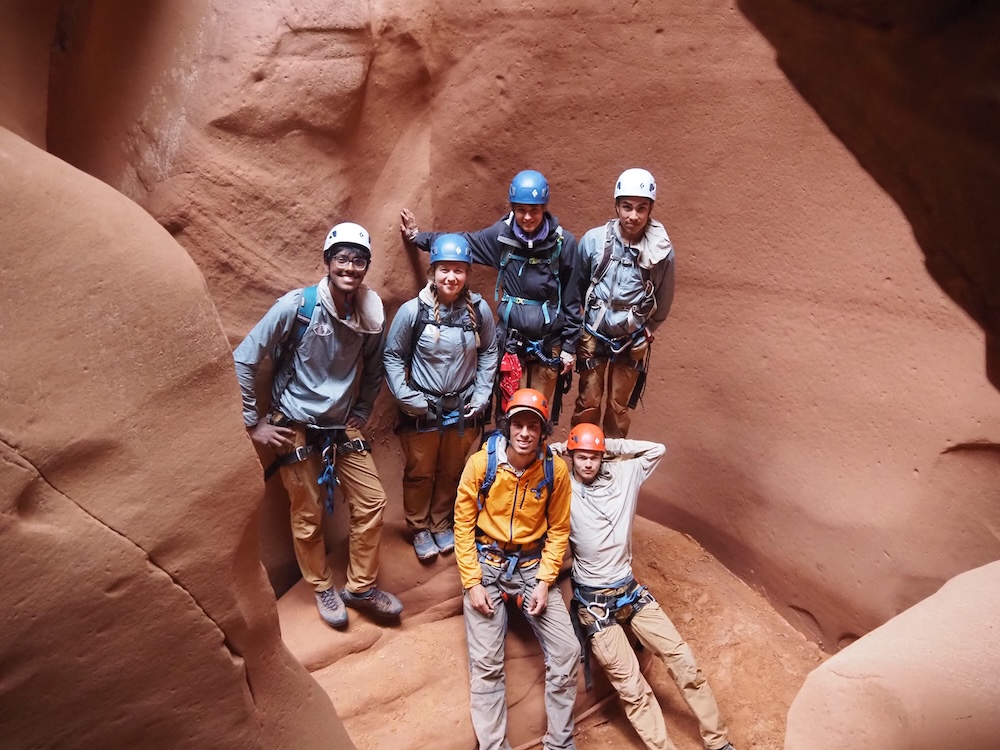
From Left to Right: Diana, Abigail, Juna, Lucas, Ana, Antonio, Caleb, Justin, Zoe, Noah, Finn (Adarsh not pictured)
Here, we begin the next segment of our assignment: we must find somewhere interesting to eat lunch, a list of landmarks spread across town, and strike up conversation with the locals. My group wants to eat our banana honey burrito wraps in a holding cell, but Paonia doesn’t have any. Luckily, the next best thing the police station can offer us is the back of a cop car belonging to a kind police officer named Garret. We eat our lunch behind the glass divide, while we tell him all about Kroka and munch on our sticky wraps. Then we get our pictures taken, thank him, and continue on our way. School has never been more interesting. After that we wander about, making a map of churches, of which there are many, small businesses and anything else on our list of interesting places. We end up wandering into a Catholic Church, where a nice woman named Stephanie gives us a forty minute tour and a little history about her religion. At the end of the day, we’ve all learned something about going up to strangers and striking up a conversation, as well as navigating our way around places we’ve never been before without the cheat method known as Google Maps. It turns out, at least in small towns like Paonia, people are usually happy to help.
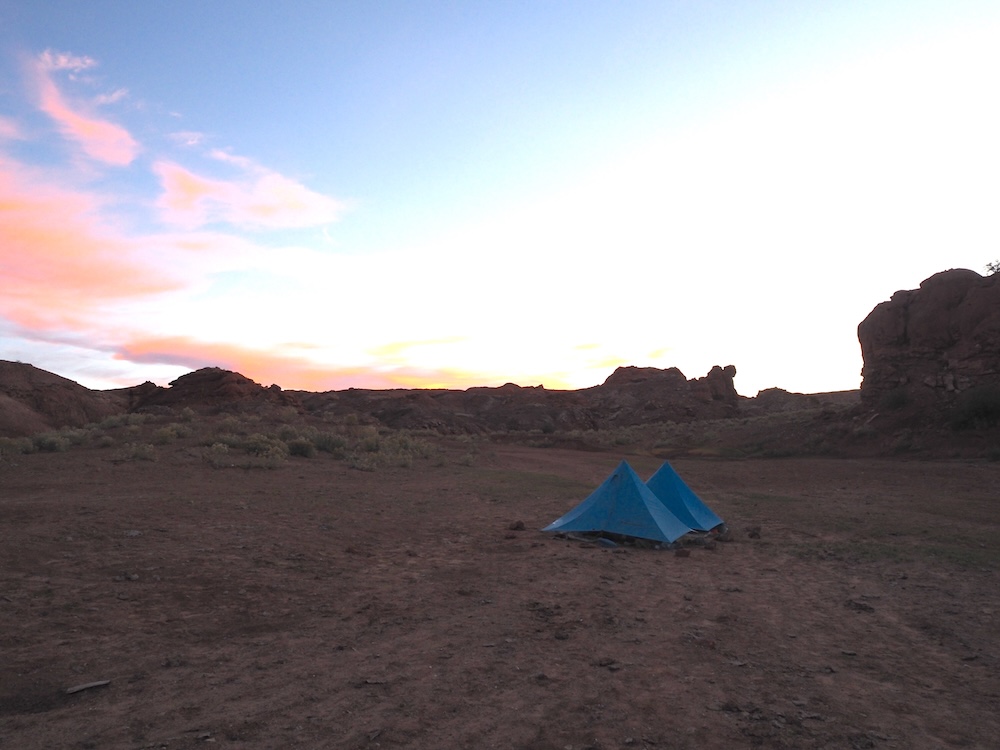 The next day we made our way up the hill from Dev’s place to meet a fascinating man named Eric and learn about his way of life. Eric doesn’t put much value in money, unlike most modern day individuals, and lives a life built off of his own skills, values, and innovation. He taught himself to build when he was young, and has followed that passion ever since, creating beautiful structures off the grid from scrap materials such as old tires or leftovers from construction sites. He is a very wise person, with lots for us to learn, but one thing stands out above all:
When you are unhappy with a situation, he said, there are three things you can do.
1) The easiest: complain and be utterly miserable about it.
2) Start the rebellion; make a change.
3) The most difficult: change your mindset and learn to love it for what it is.
We don’t necessarily realize it in the moment, but we’ll be thinking about these three options a lot in the weeks to come.
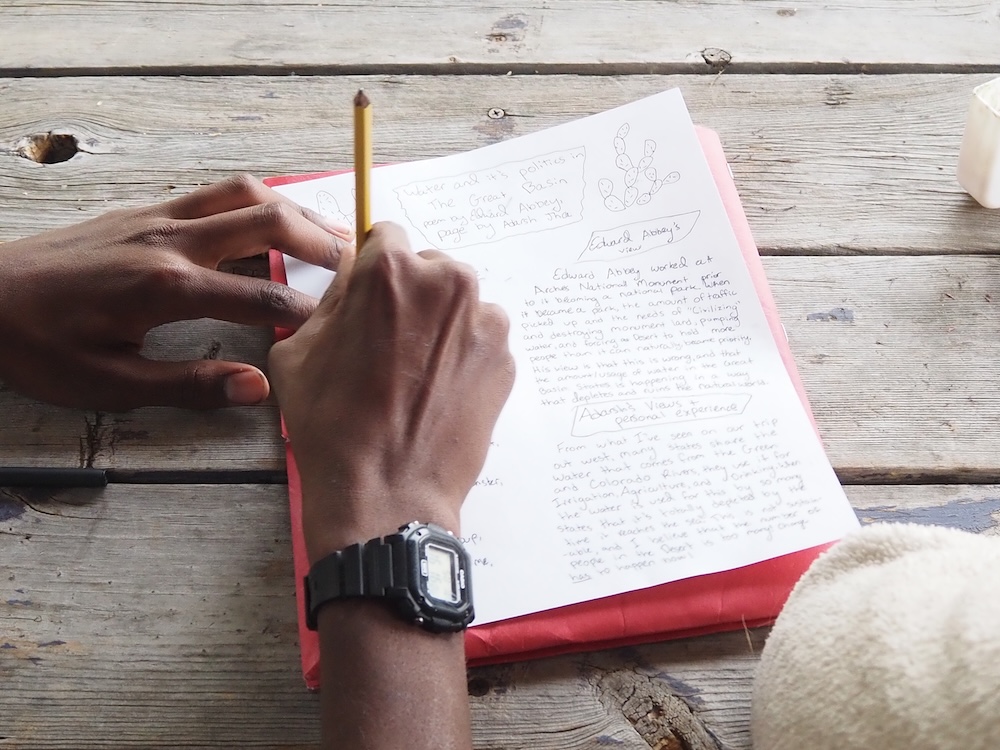
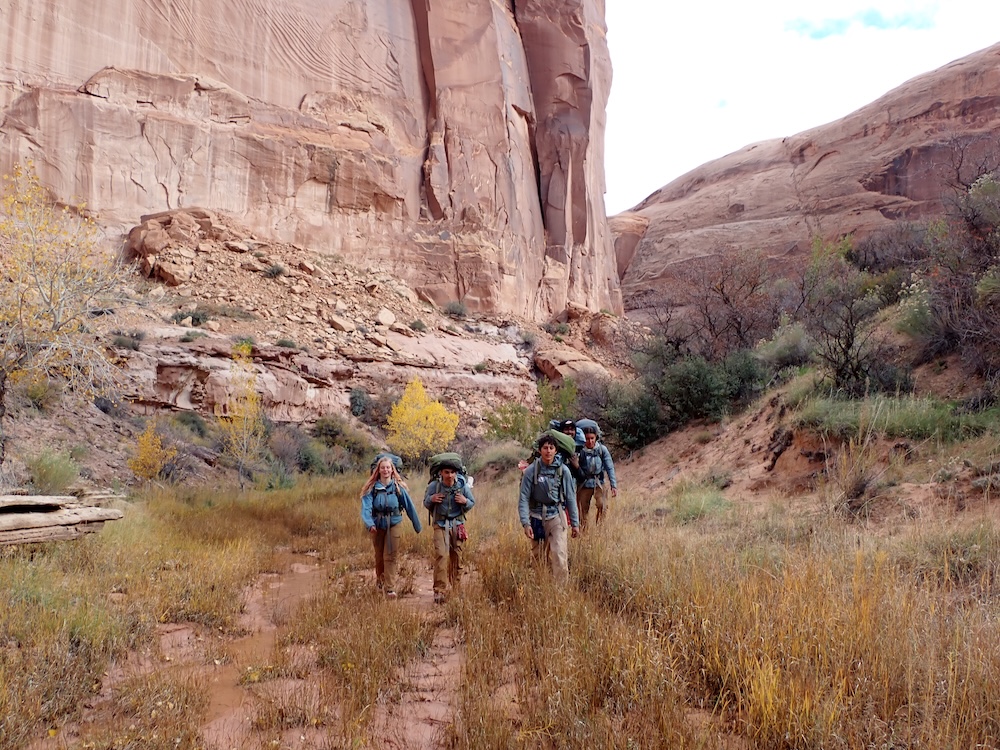 The rest of our week spent at Dev’s flies by, as we alternate between classroom learning on the Southwestern water crisis and preparation for our first meeting with the Dirty Devil River. On our final day, we say our goodbyes, give a hearty thanks to Dev, and load ourselves into the van—a place that is beginning to feel like home.
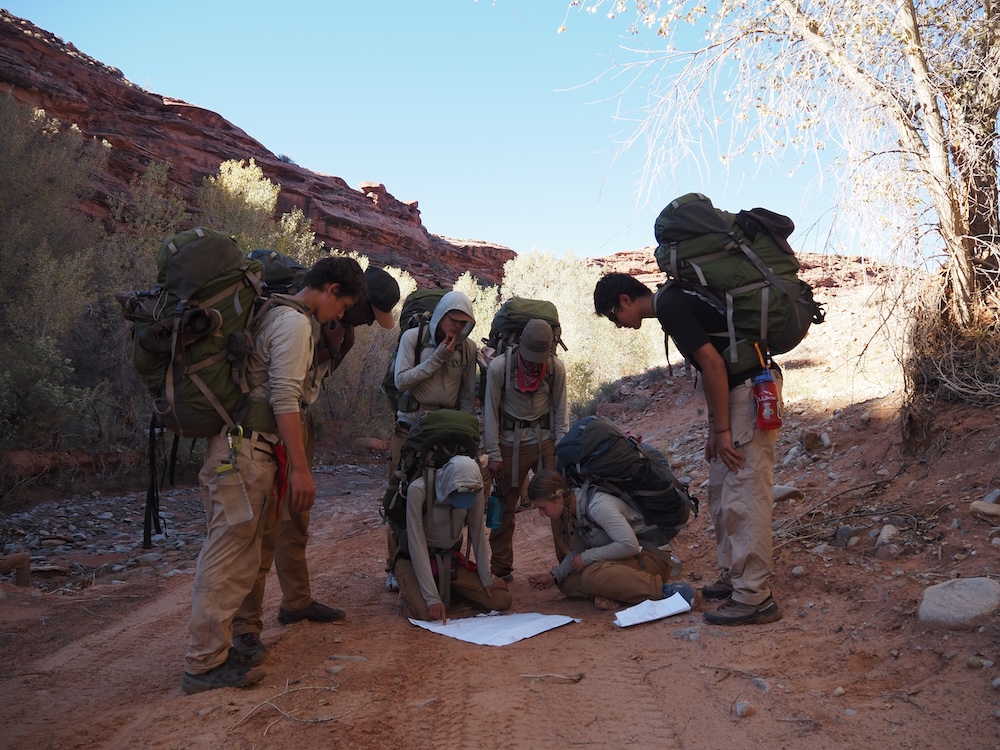
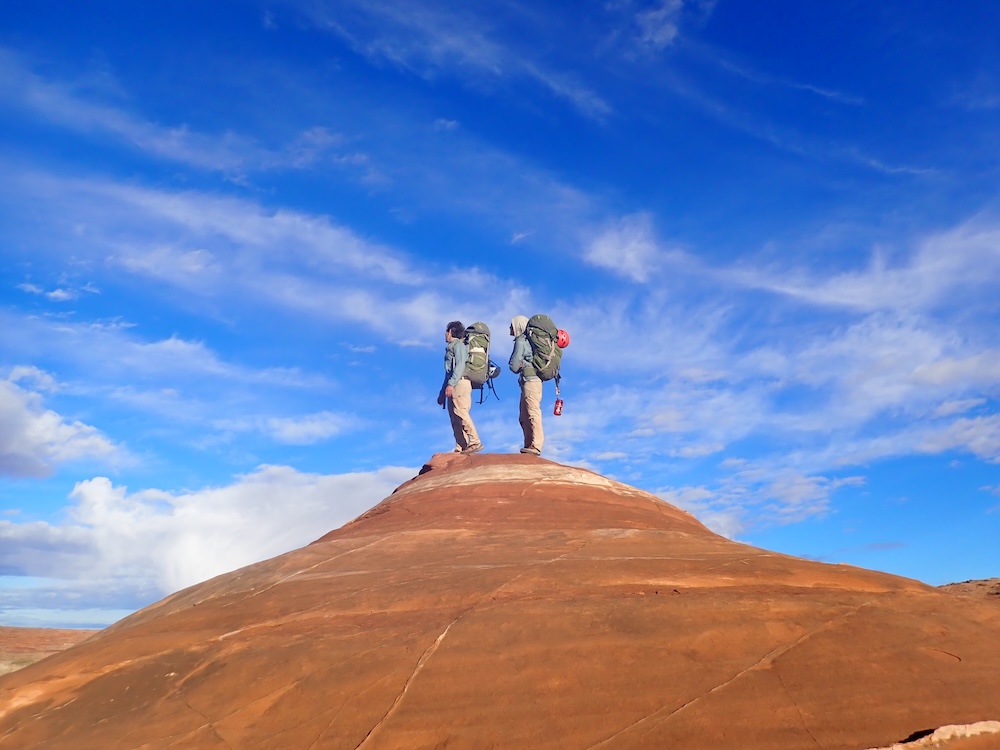 When we arrive at Poison Spring, the climate is hot and arid, and not a cloud dares to linger in the sky. Oh the wicked irony. Many of us have never been backpacking before, and even for those who have, it’s still a stark adjustment to be carrying a 50 or 60 pound pack for ten or so miles a day. It takes two days to reach the slow, non-threatening trickle that is currently the Dirty Devil, and by the time we arrive, most have acquired blisters or strains and everyone’s bodies are sore. We encounter our first rattlesnake on our way down the canyon by nearly stepping on it, and after that we are all more careful where we place our feet. The views are amazing in the fall sunlight, with the soaring canyon walls and shiny pieces of jasper and chert scattered across the ground. We set up camp on a large, flat area on a river bend, and for a moment, we take a breath. Then comes the rain. Heavy, unending, torrential rain.
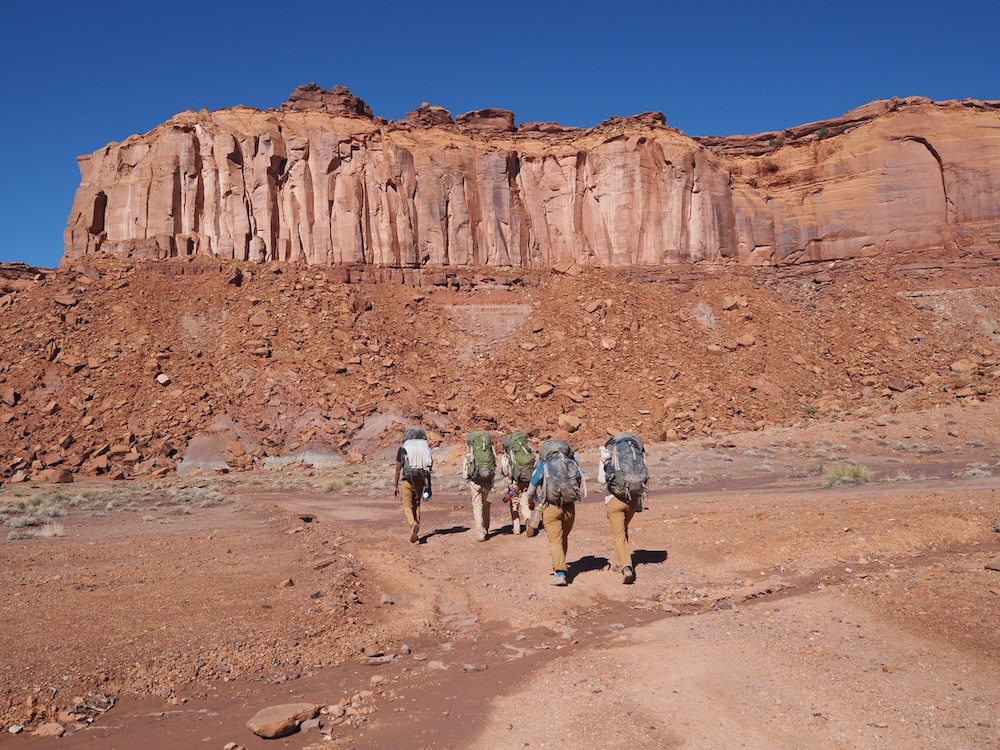 On the Mesa
I can see far as an eagle
Hundreds of miles away
In the canyon,
I can feel the breeze on my skin
The beautiful walls of the canyon
Unnaturally large, yet naturally stoic
The desert sky, blue and shining
Beautiful against my red backdrop
This land is so new, so beautiful
Thought provoking and spirit testing
~Adarsh
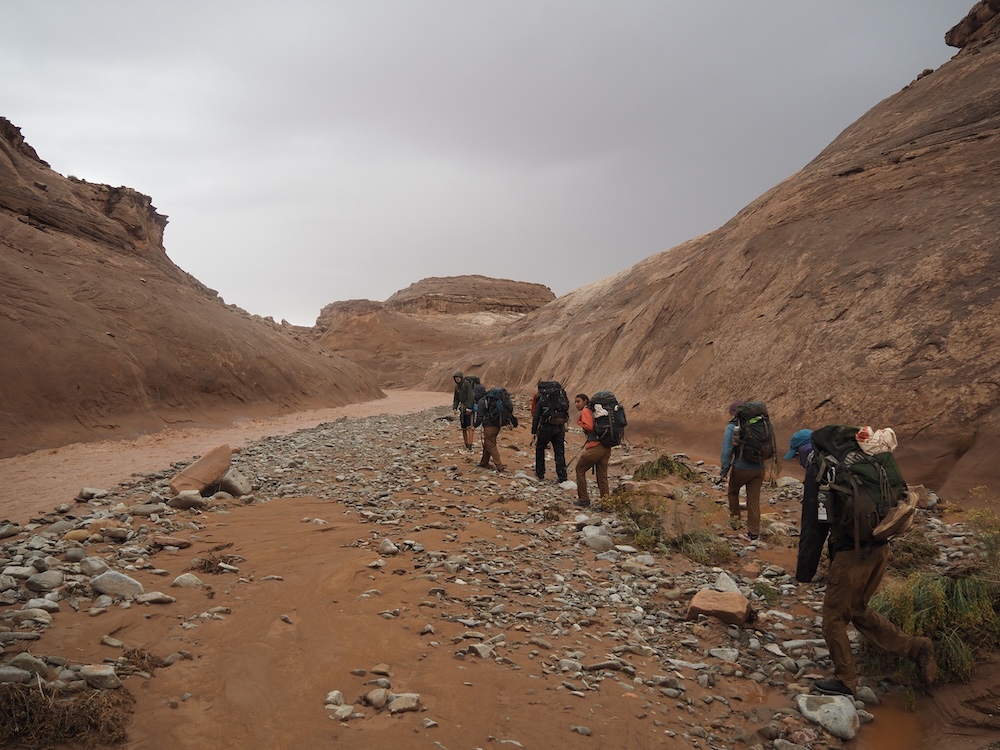
We quickly learn to dig trenches around our tents, lest they flood, and use large rocks rather than stakes to hold them up in the soft sand. Sometime that night, as the rain beats steadily downwards, we are awoken to the tremendous crash of huge rocks tumbling down the canyon side, followed by the distant rumble of thunder. After that we try to steer clear of the canyon walls, though most of the time they cannot be avoided. The next day we layover at camp, hoping in vain that the rain will cease and watching dubiously as the river begins to rise from a small stream to a raging torrent of silty rapids. It rains all morning, afternoon, and night, and when we set out the next morning it is still battering the ground in heavy sheets. The river has become enormous and is still rising, and we’re supposed to make our way eight miles up stream, crossing whenever the need arises.
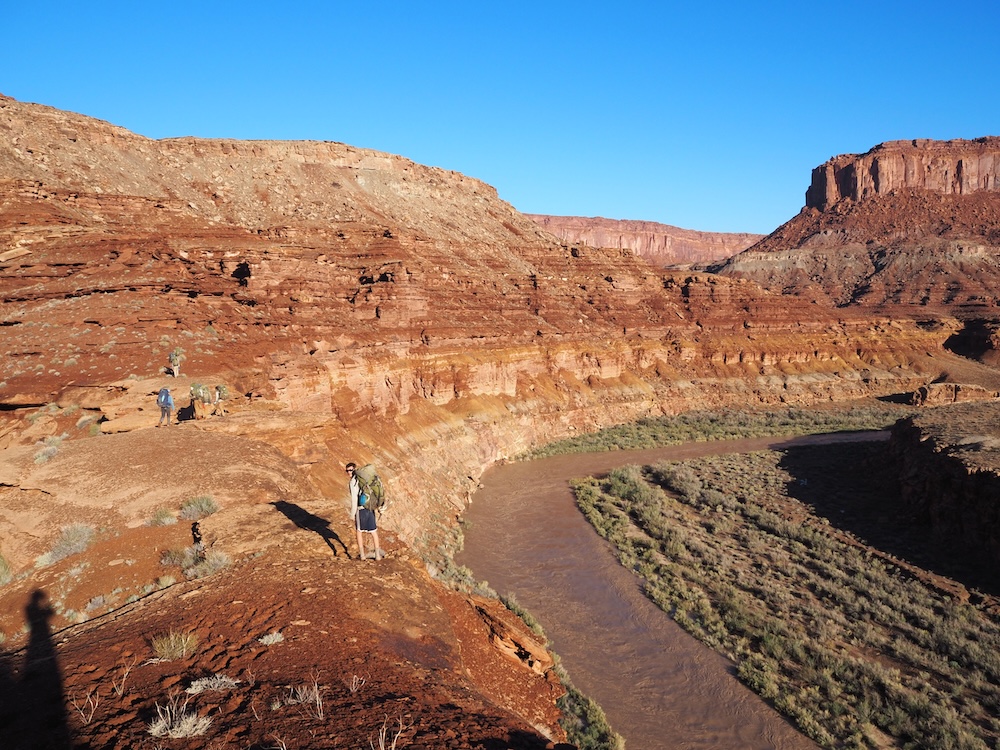 We set out in high spirits, wading through the current and quicksand when the walls are narrow, and bushwhacking through the thicket when the terrain allows. We don’t realize it just yet, but we are now facing what is probably one of the hardest days in the entire semester. We stop to greet a grumpy rattlesnake hiding from the rain. When the last of our group is fifteen feet or so from the canyon wall, the wall begins to crumble, sending soccer ball sized chunks of sandstone tumbling down. At this, we try to take Eric’s advice, and love the situation for what it is. Five hours and about two miles in, drenched, freezing, and covered in mud, we realize the Dirty Devil has successfully thwarted any path forward and become utterly impassable. Water stretches from wall to wall and it is too deep and fast to cross even if there was adequate terrain. With a mix of relief and sadness, we make the decision to turn around and hike back out the way we came.
 I love you
What little thinking I do, I do on government time
They tell me what to
How to have a thought
How to love and lose a life
And how to pay for all of it
To die
You must pay a fee
To think you must give a leg
To love
You must give an eye to the ever consuming maw
That is the government
It will drown your peace
Consume your life and name your fever wrong
But every flame they ever drowned was someone’s brightest song
So bring me all your woes all your fears and all your pain
All the tears you ever cried in the government’s sorry name
~Diana
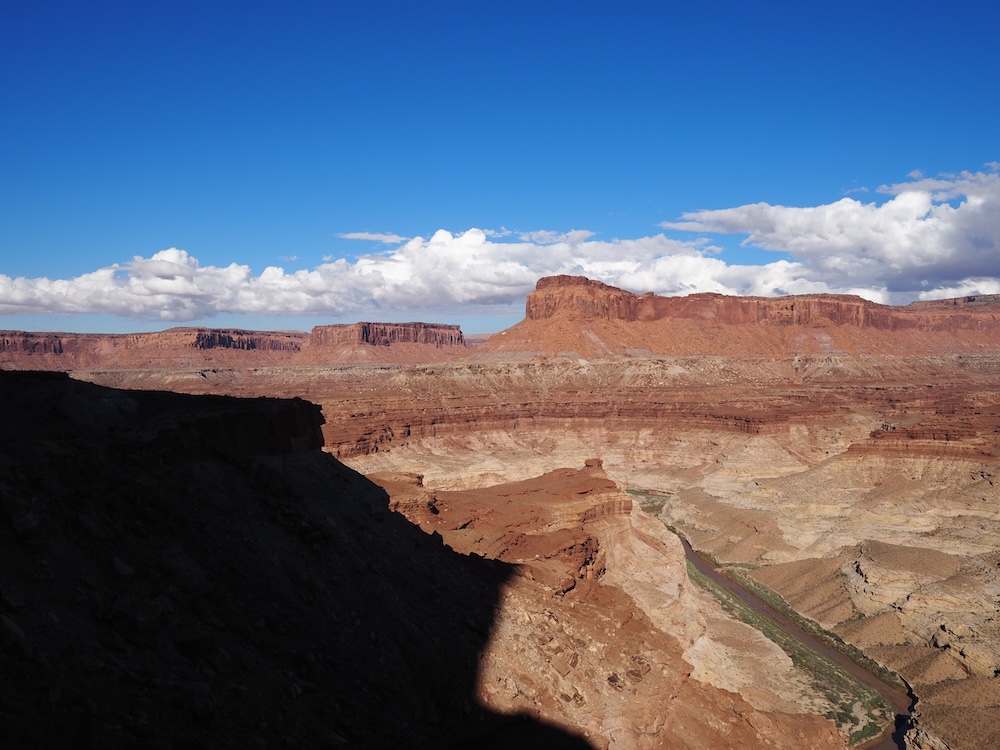 After bushwhacking our way back to the nearest open area, we set up an emergency camp and try to reflect on all the wondrous benefits of total and utter failure. That night our decision is confirmed to be a good one when the river swells so much that it appears to rival the Green in size. In the morning we climb out of the canyon, avoiding more rockfall, and begin our journey back out of Poison Spring. The rain has finally paused, at least for the moment anyway, and we reach our camp after a beautiful thirteen mile hike through the sunlight, slightly soggy environment.
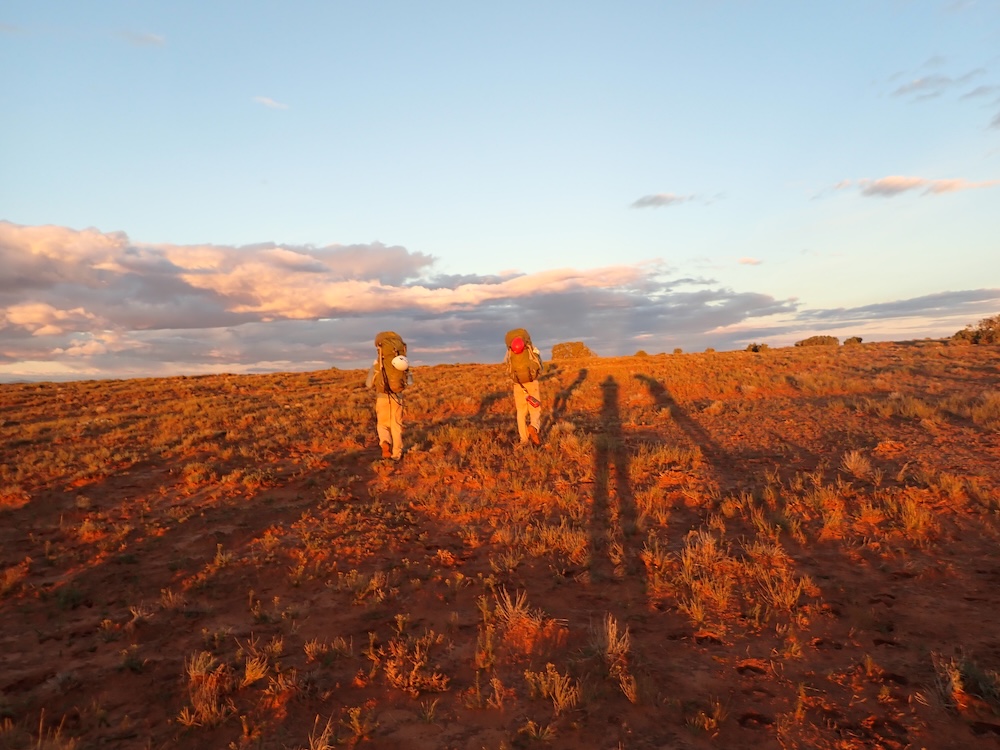 Our final day is another of the most difficult we’ll face, and in the spirit of our upcoming independent student group expedition (ISGE), we do it on our own. Everything runs smoothly until about half a mile down the trail when the rain loudly announces its return. In Poison Spring, the road and the wash are one and the same, and so, when the flash flood comes, there is nowhere to go but through. We move as quickly as possible, without jeopardizing the group’s well being, as the water rapidly rises from ankles to knees. We are anxious to get out of the canyons and onto dry ground.
When the road finally takes us up onto the mesa top, everyone breathes a sigh of relief. We arrive at the highway an hour earlier than expected, where we meet Gracie and Keane and swap stories of our adventures while we wait for Dave and the van. At this moment, our immediate future is completely unknown. We were supposed to hike straight to Robber’s Roost, after climbing out of the Dirty Devil, but since our plans were foiled by historic levels of rain, we are now very much in the wrong place. It turns out we get to take a two night layover at Green River State Park, while we wait for the roads to clear. Our time at Green River is spent recuperating from one expedition and preparing for the next. It may have been unplanned, but it was worthwhile and we are grateful for the break in what would have been a three week expedition.
 Finally, we load into the van and make our way to Robber’s Roost Canyon– far, far, from any form of civilization. Here we are split into two groups of six, and it’s bittersweet to say goodbye to the people we’ve been with all day every day for the past fifty days. One group goes to a campsite nicknamed Motel 6 for its dilapidated shack, and the other goes to Robber’s Roost Spring, which is sheltered by giant cottonwoods and filled with cow patties. The camps are about six miles apart, and for the next leg of expedition, our group dynamics are entirely different. Closest friends are placed in separate groups, ensuring everyone makes new connections with different people.
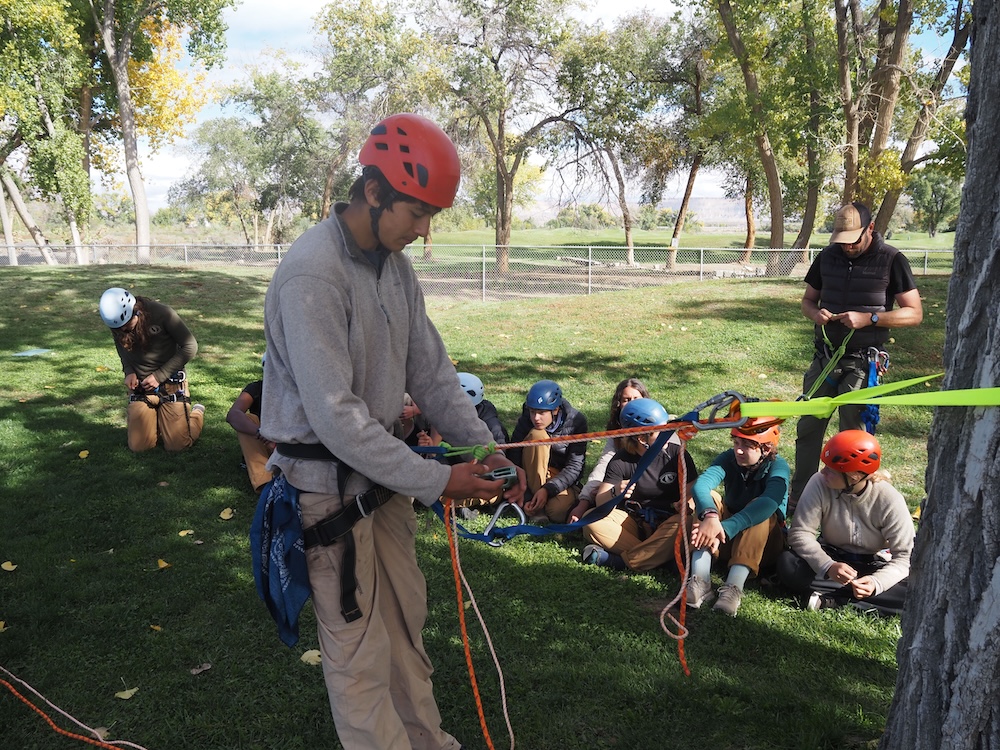
Lucas practicing rope systems ahead of canyoneering
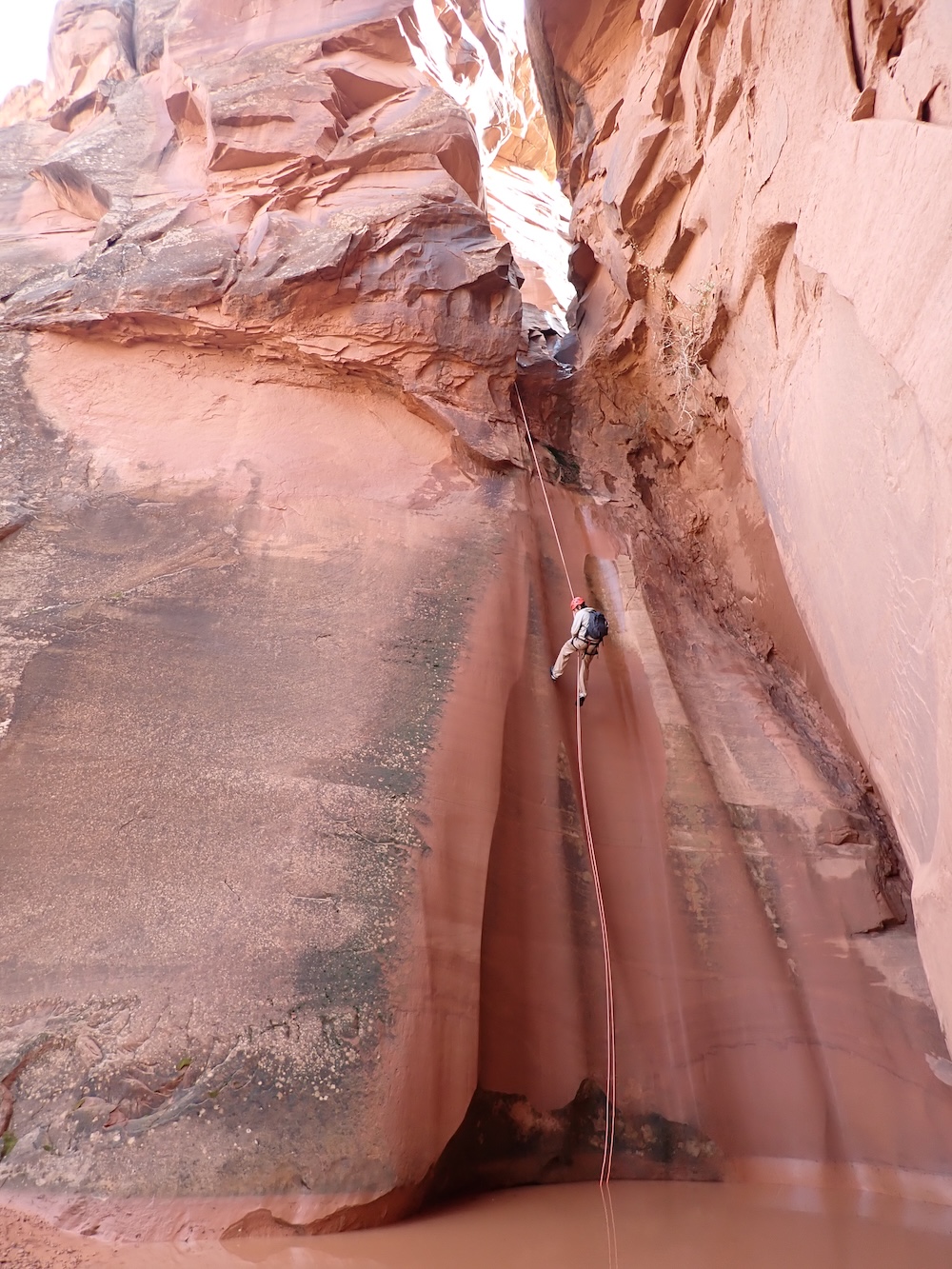
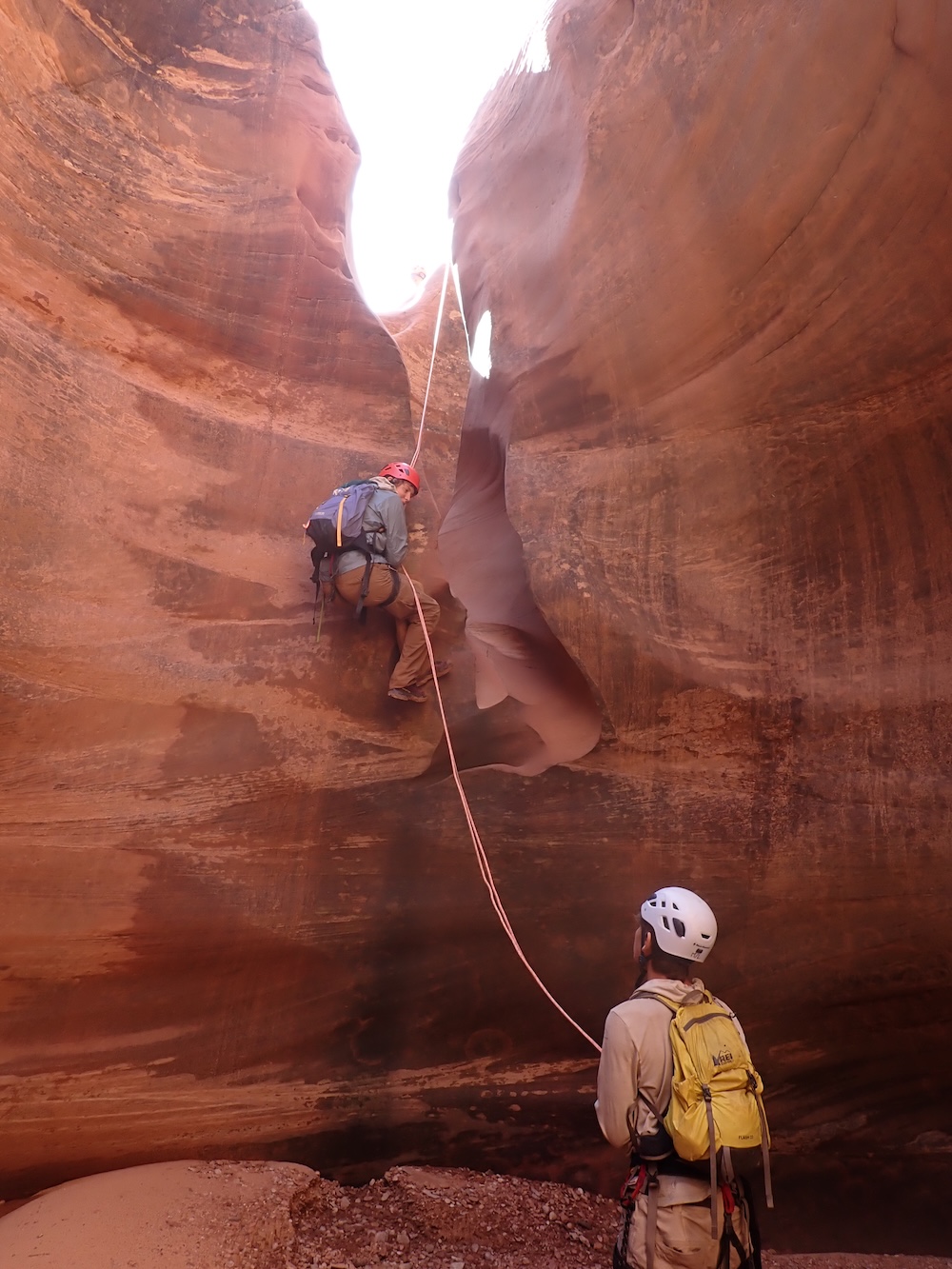
Canyoneering is perhaps one of the most breathtaking parts of semester so far, filled with stunning, hidden away pieces of the world and enough excitement to make the hair stand up on the back of your neck. Slot canyons are narrow crevices that penetrate deep into the earth, sometimes hundreds of feet down and only a few feet wide. They are created just as any other canyon is—by the river slowly carving deeper into the sandstone over the course of millions of years. Luckily, the clear weather holds, and on the first day my group descends into Sam’s Mesa Box Canyon.
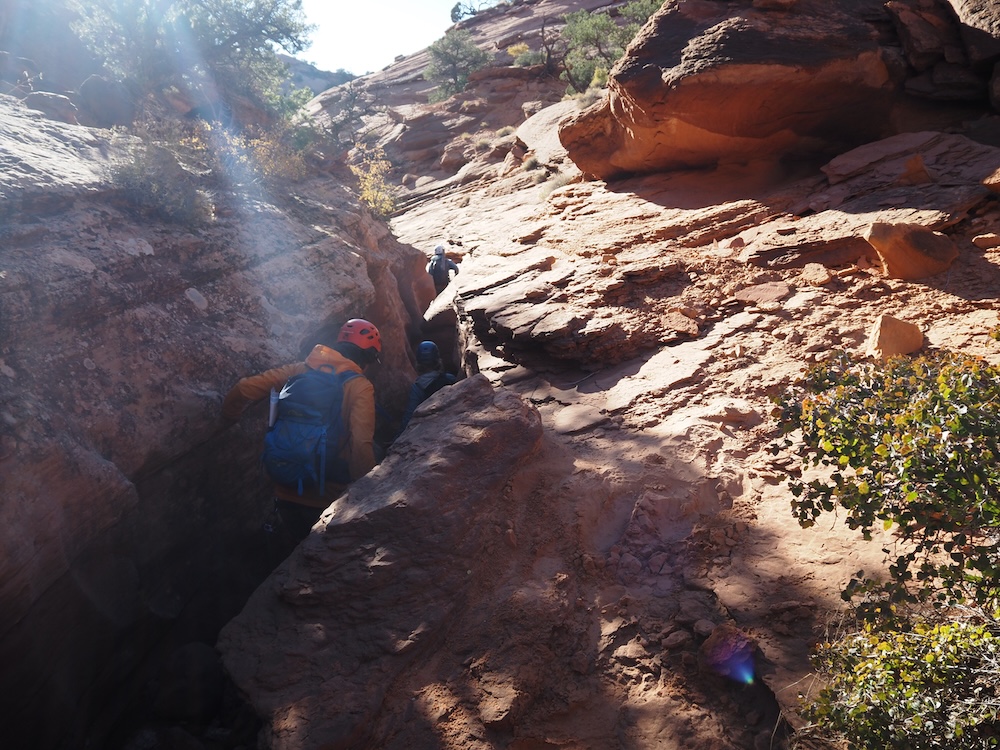
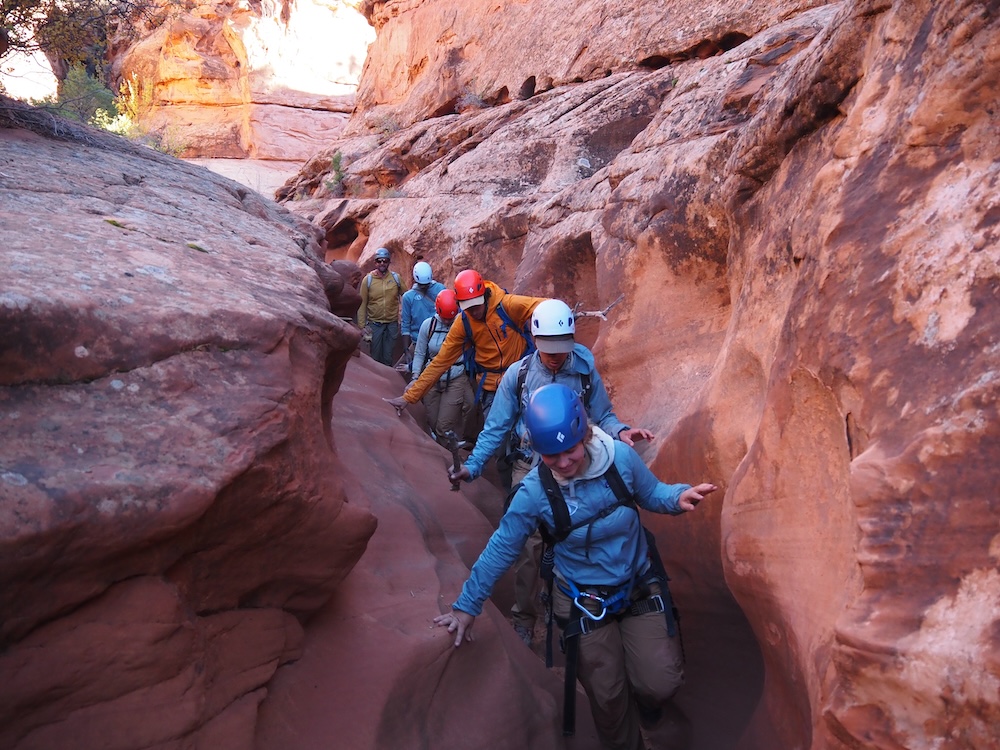 After our initial forty foot repel, the temperature immediately drops as the sandstone walls soar above, encasing us in cold stone. A thin sliver of blue sky illuminates our descent as we explore deeper into the canyon. Our next repel takes us perhaps another sixty feet downwards, bringing us through narrowing walls and icy, stagnant pools of water left over from the storm. Then, the walls widen out into broad daylight and we walk along an oasis of juniper trees and dazzling views. The slot has run its course, and now our only task is to navigate our way to an area where the walls slope gently enough to climb out.
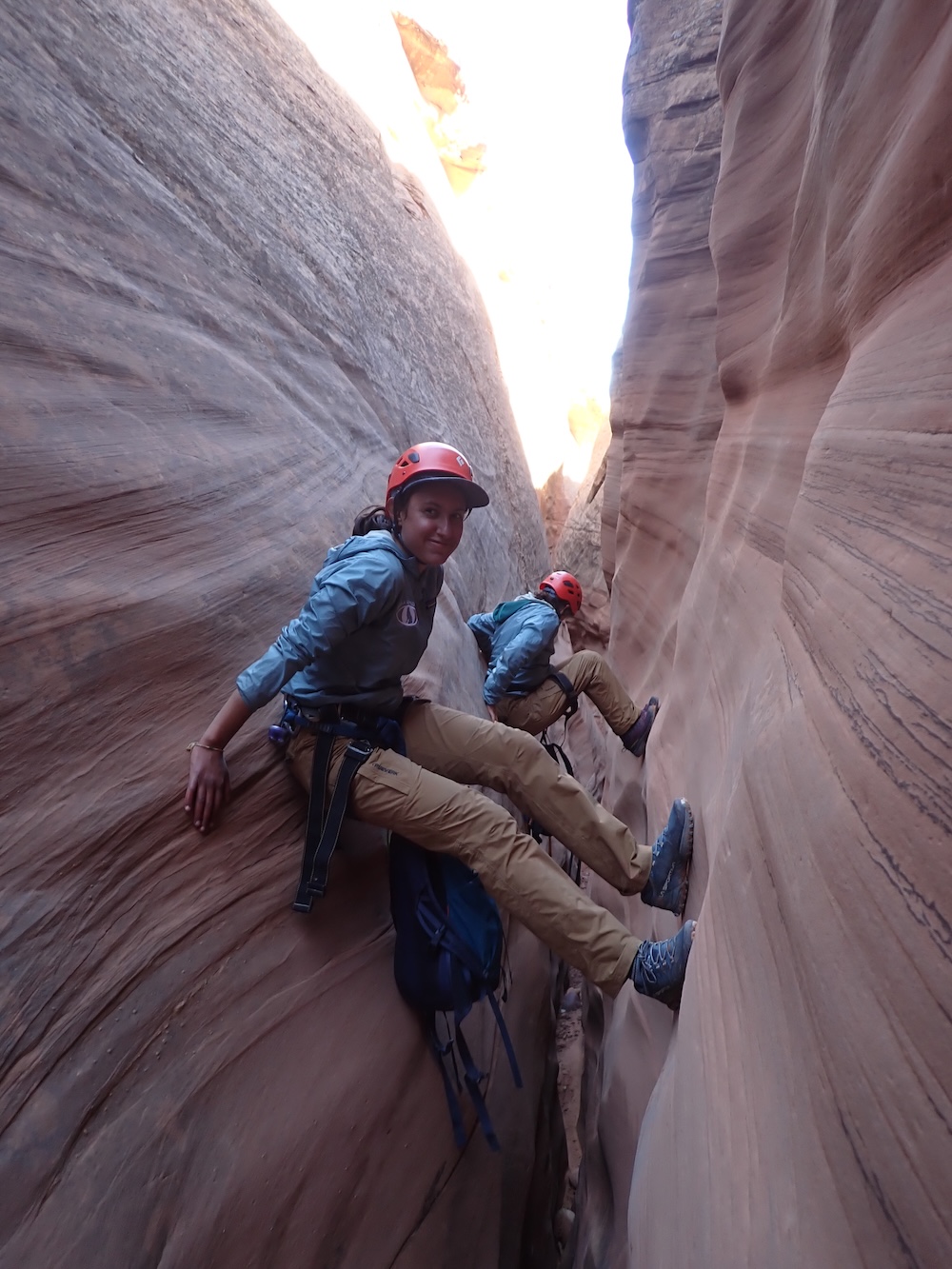
Ana headed into the slot canyon
Because the roads are too washed out for the van, we do extra walking that day, but no one complains. There’s something special about pulling ourselves from the canyons and walking several miles up a desolate, dirt road through the crimson sunset, and into the stars. Despite, or maybe because of, the aches and pains of long, tiring days, there is a feeling of being so very alive and present within the moment. We spend the next few days exploring slot canyons in the area, until we are eventually halted once more by the prospect of rain.
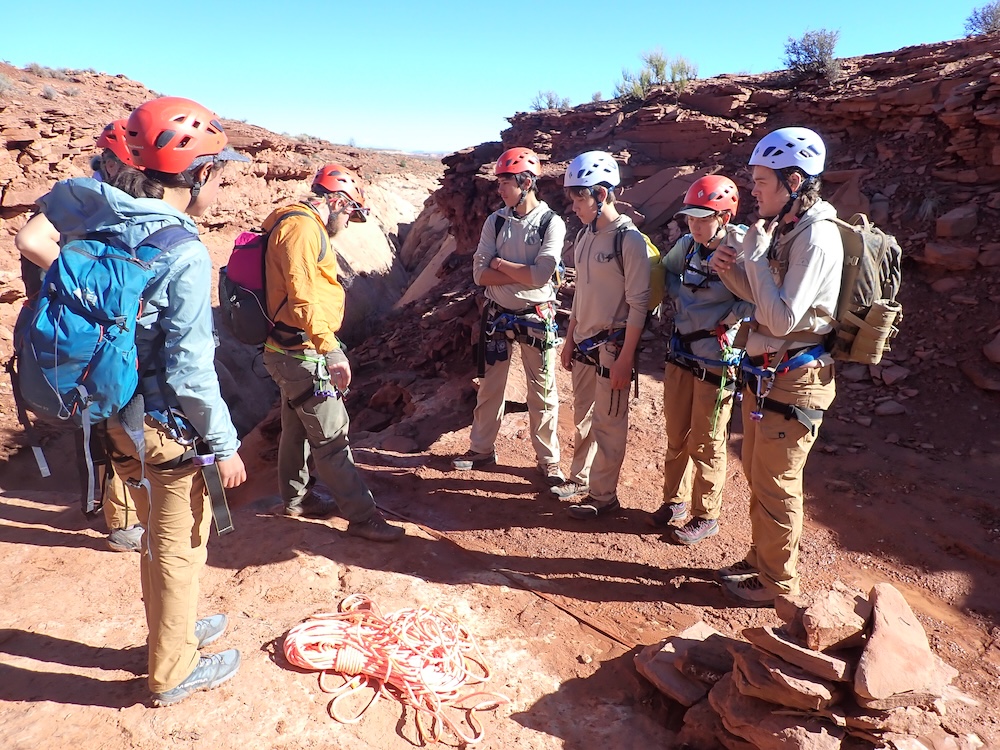
Caleb, and half of the group, setting up their rappel into the canyons
Slots are technically just very narrow washes, and so you never want to enter one if there is even a hint of rain falling from the sky. Instead, we hike down into the upper section of Horseshoe Canyon to visit the famous Great Gallery of pictographs made by ancient people that predate the Anasazi.
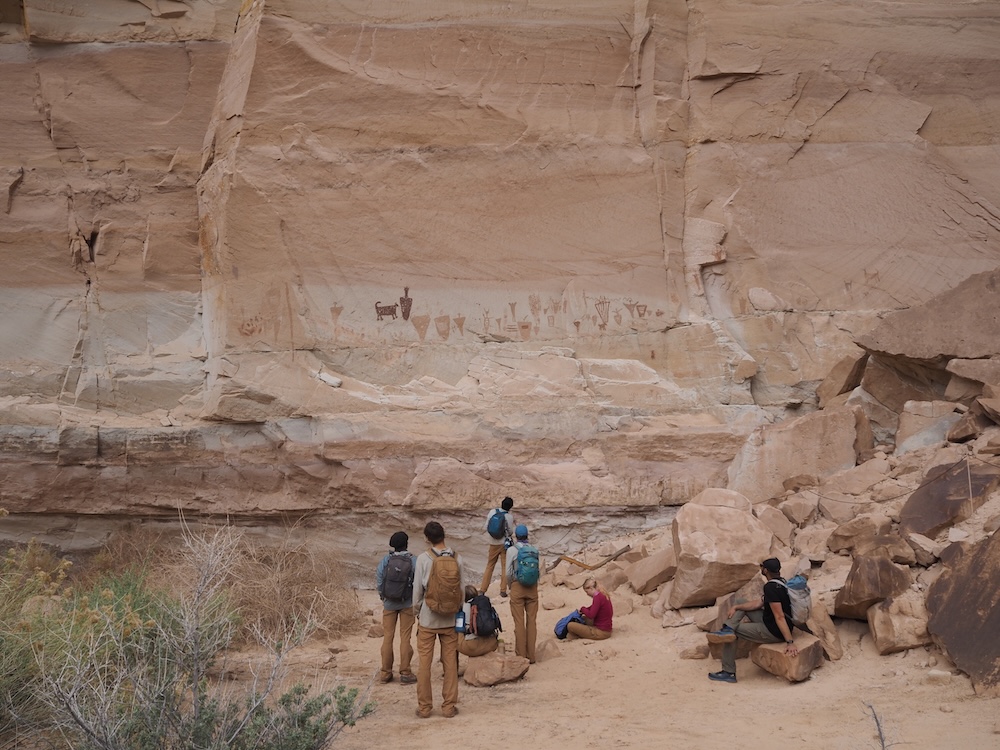
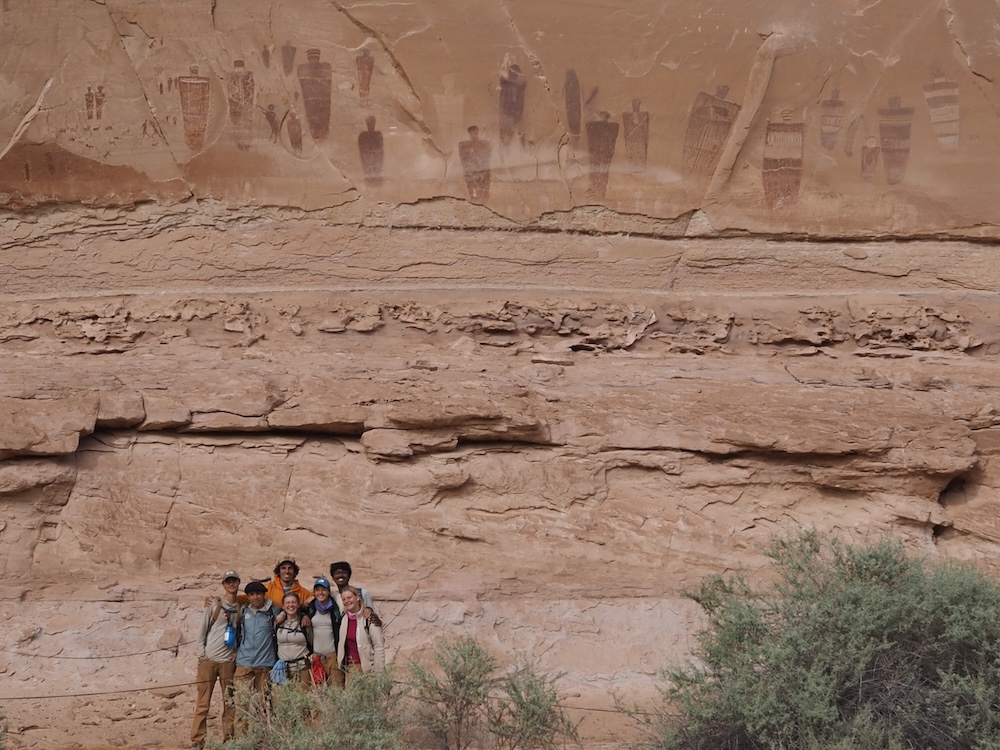 It is estimated that some of the spirit-like carvings in the rock date back to seven thousand years ago, the most impressive of which reach eight feet in height. Staring up at the humanoid figures etched into the rock, it feels as though the hazy ghosts of the past are looking back at us through the river of time. Their faces are scarcely visible, but still they watch, an ancient remnant of a world almost entirely left behind.
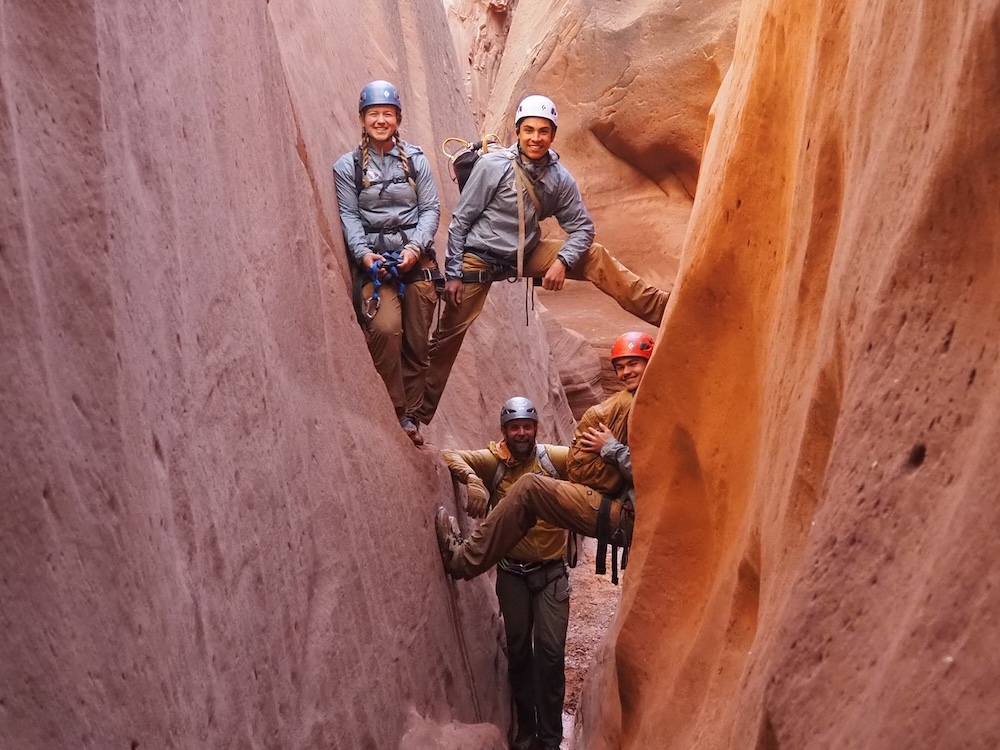
Juna, Antonio, Dave and Caleb
A Poem
The wall takes their voices
Absorbing the sound
Then pause, thoughtfully
Memorizing and understanding
The pitch and tone
Then a response
An invitation
Emerges from the stone
A strange voice
Mimicking a familiar one
Not a perfect playback
Adding something of its own
An eerie twist
From a far off place
Adding secrets only canyon walls know
A mocking from the rock
An echo all alone
~Ana
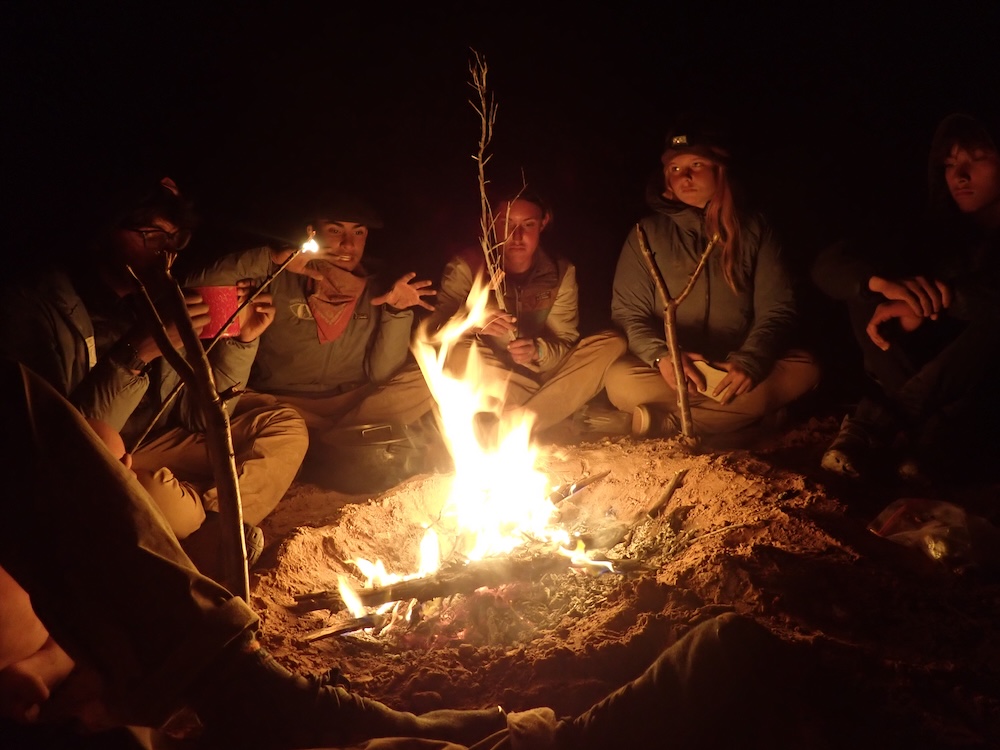
 On Halloween, the Motel 6 group make their way to Robber’s Roost Spring and the groups are reunited. They arrive just as we have finished our halloween costumes of desert plants, cow bones, and anything else we can find.
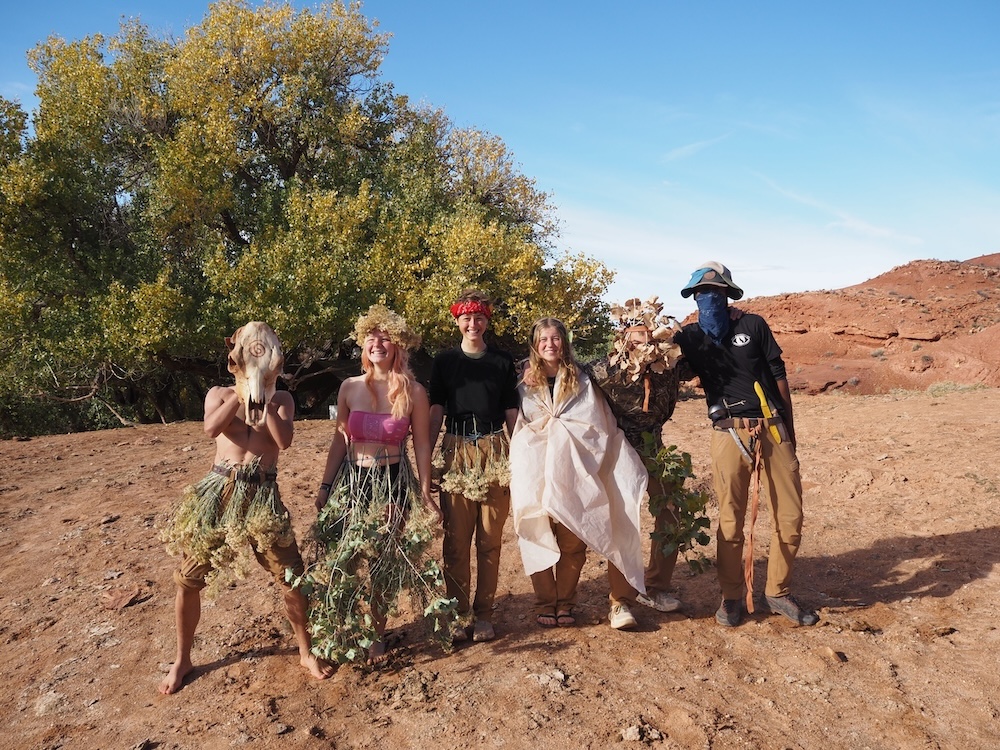 We are about to initiate our trick or treating process, but we are instead interrupted with the joys of seeing our friends several hours early. Though the reunion is sweet, we won’t be together for long. Once the two groups have meshed back into one, we begin preparation for the culmination of our backpacking journey and essentially everything else we’ve learned on semester: ISGE.
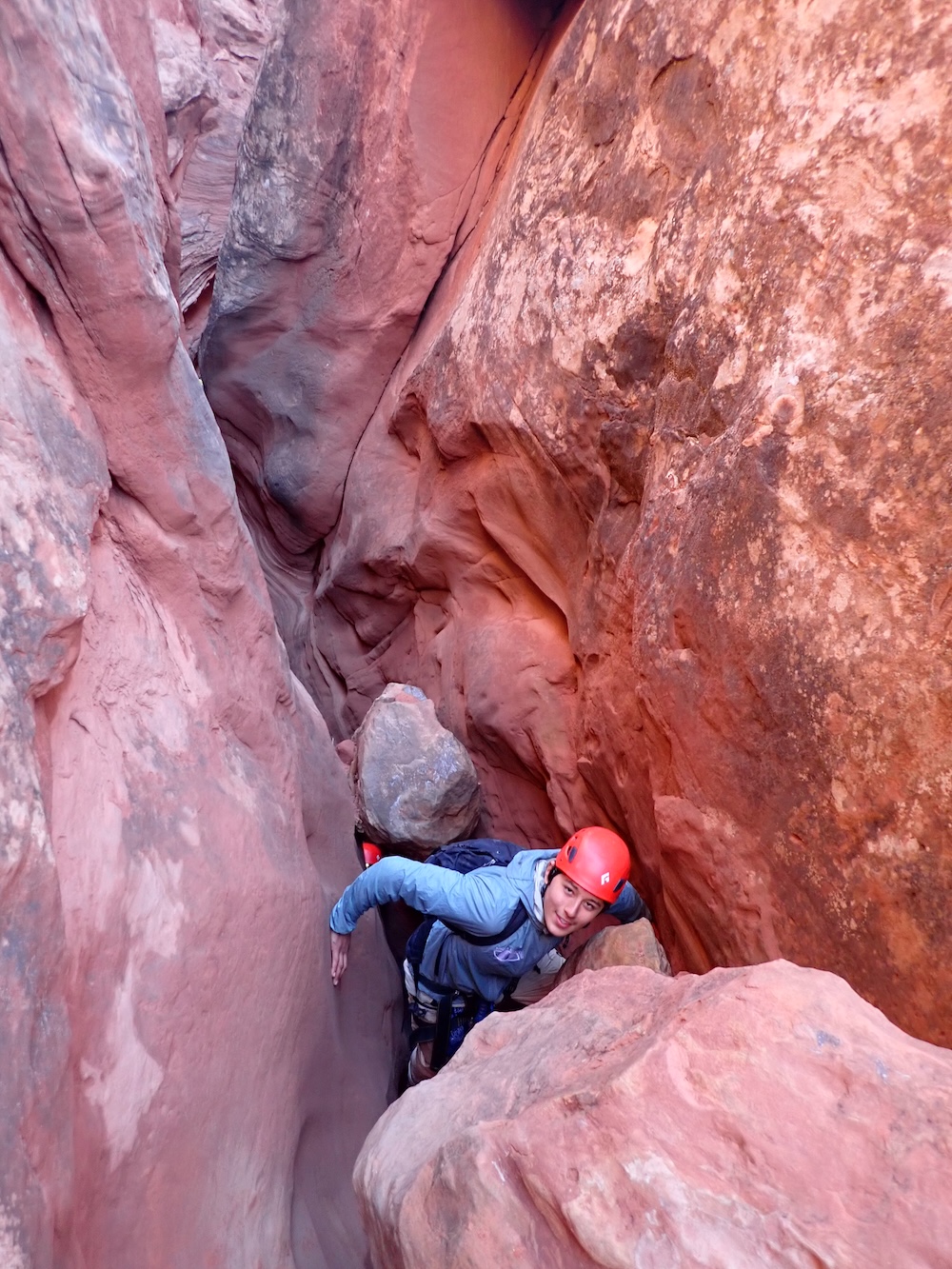
Lucas negotiates the canyon
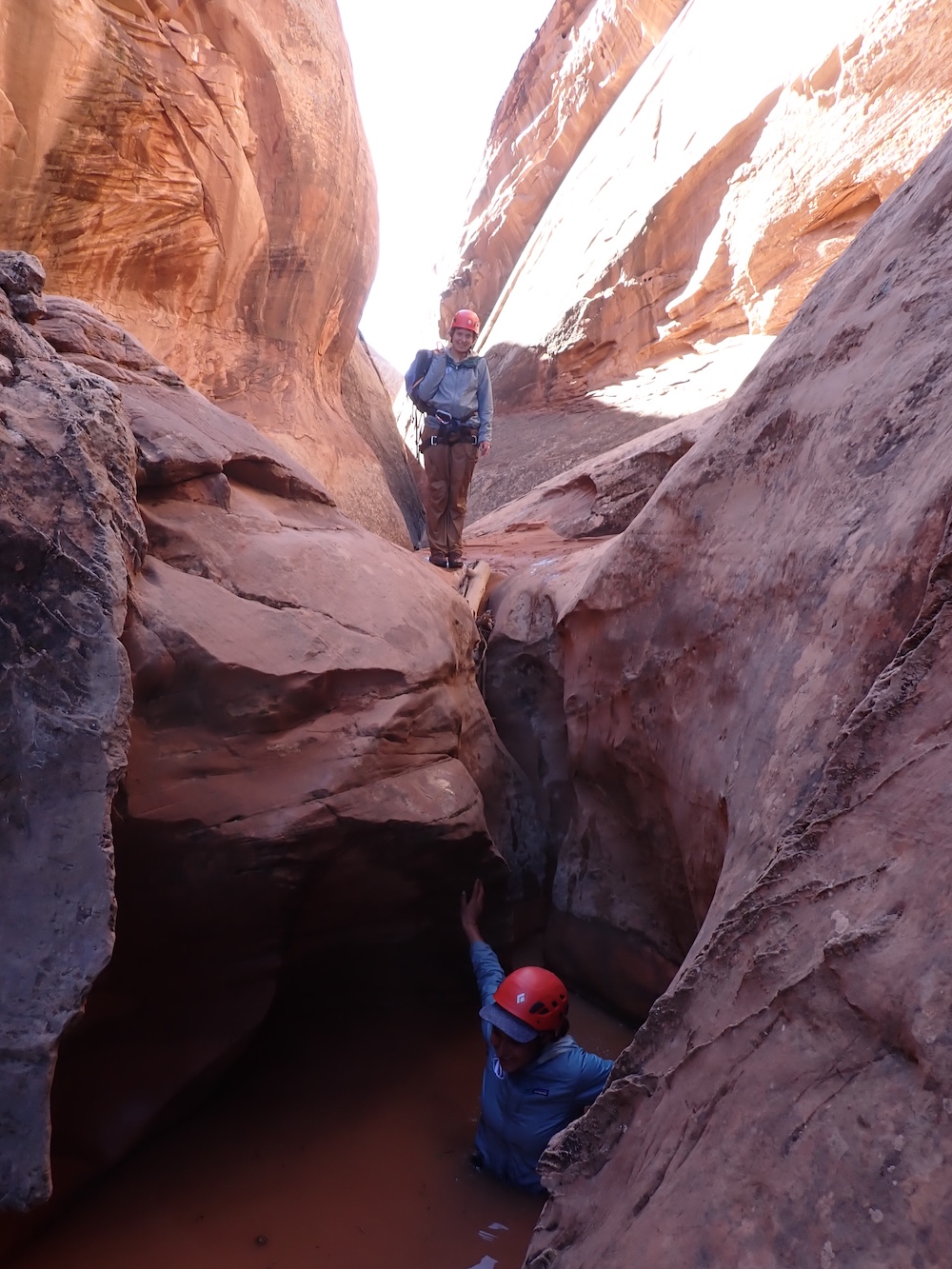
Noah and Ana and the cold, cold water of the slot canyons
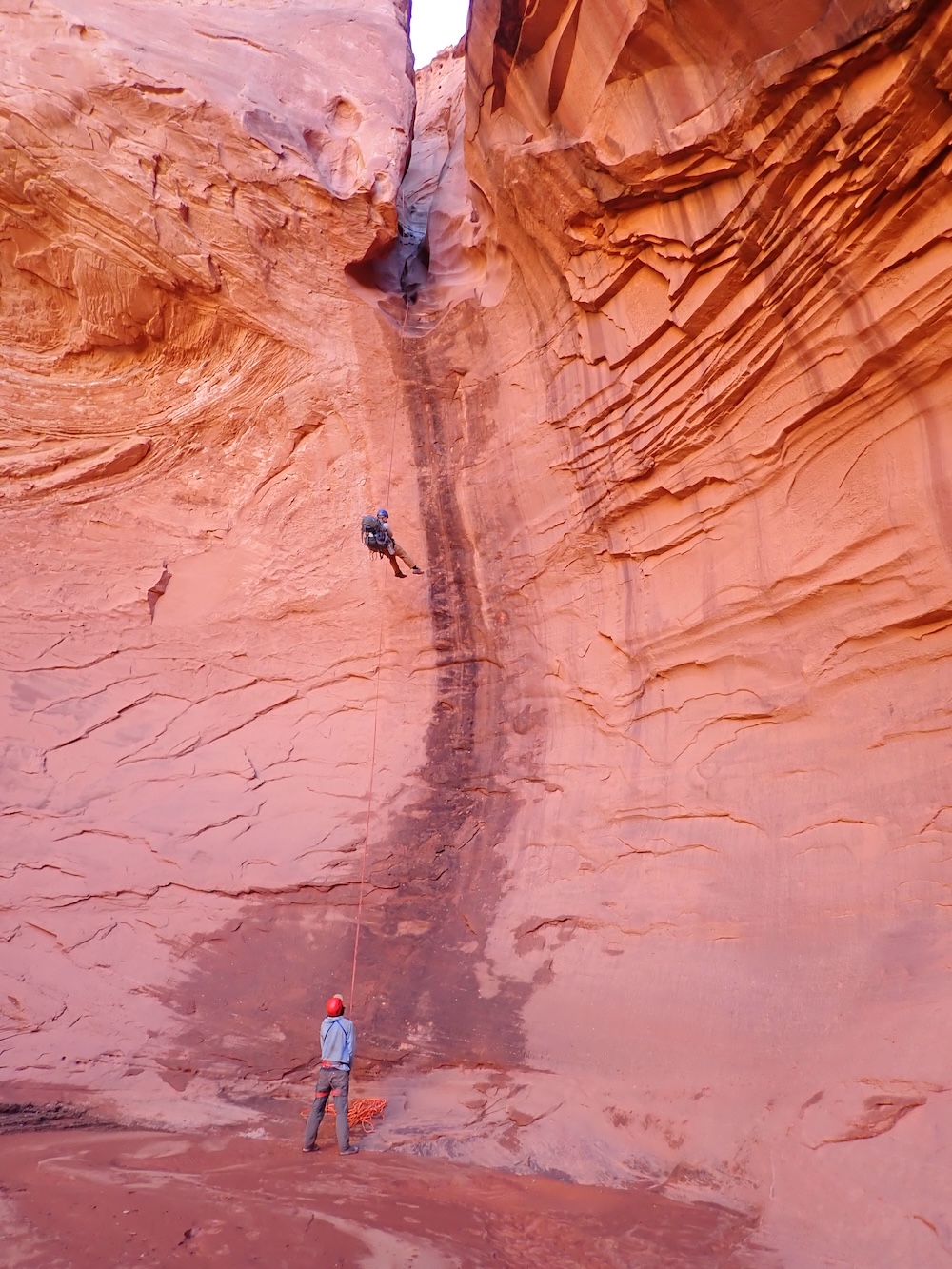 Here we are split into two new groups of six for our return to the Dirty Devil River. ISGE begins with a hundred and eighty foot repel into the middle fork of Robber’s Roost Canyon, where we split into groups and continue our expedition to the river without instructors. Suddenly, there is no one there to catch us if we fall—except, of course, each other. We’ve worked hard for this, and a sense of both pride and responsibility weighs heavily on our shoulders as we make our way down the canyon. Cottonwoods are scattered across the rocky floor, and flowers bloom everywhere we look.
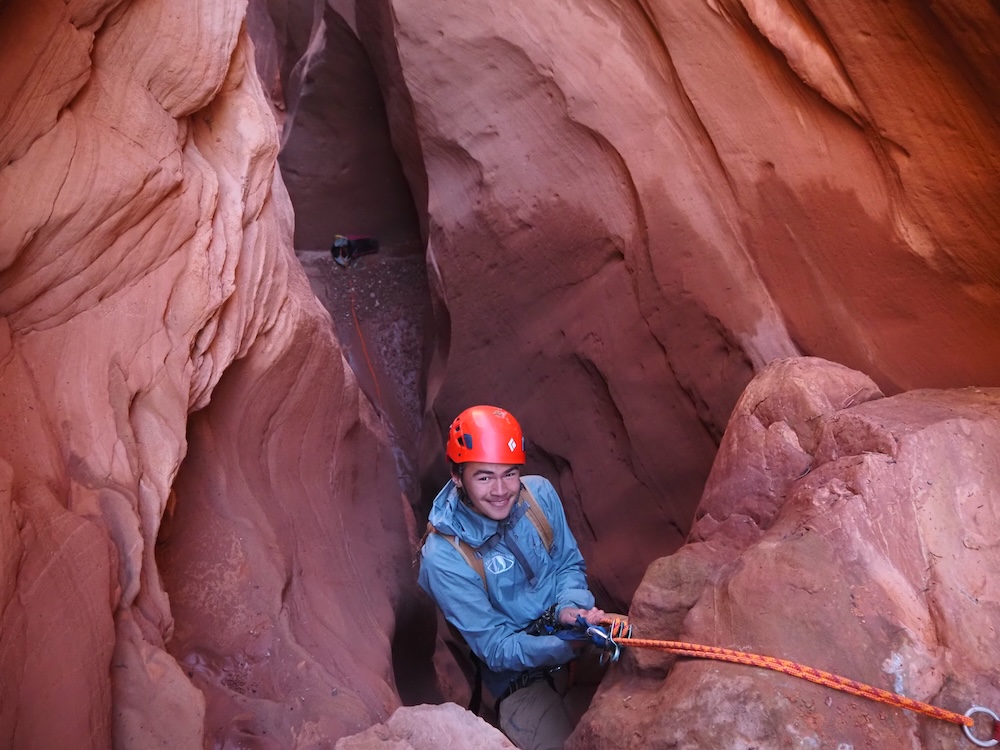
Caleb descends
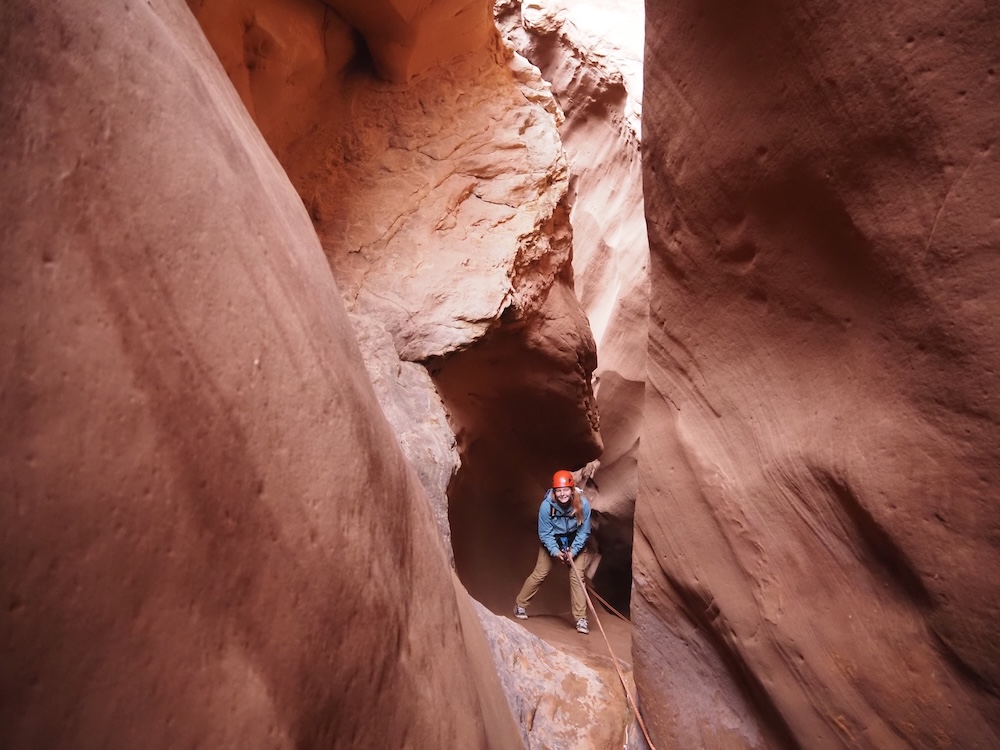
Abigail descends
It’s easy to see how prehistoric humans once thrived here in a place the modern day media makes out to be a desolate wasteland. We only spend one night in the dry comfort of Robber’s Roost, before meeting Keane and Caleb at the mercifully much lower Dirty Devil for a lesson on safe river crossings. They cheerfully tell us there’s no quicksand in the river, so long as you avoid the mud flats. We immediately learn there is, in fact, quicksand in the river. It feels as though we’ve been reunited with an old acquaintance.
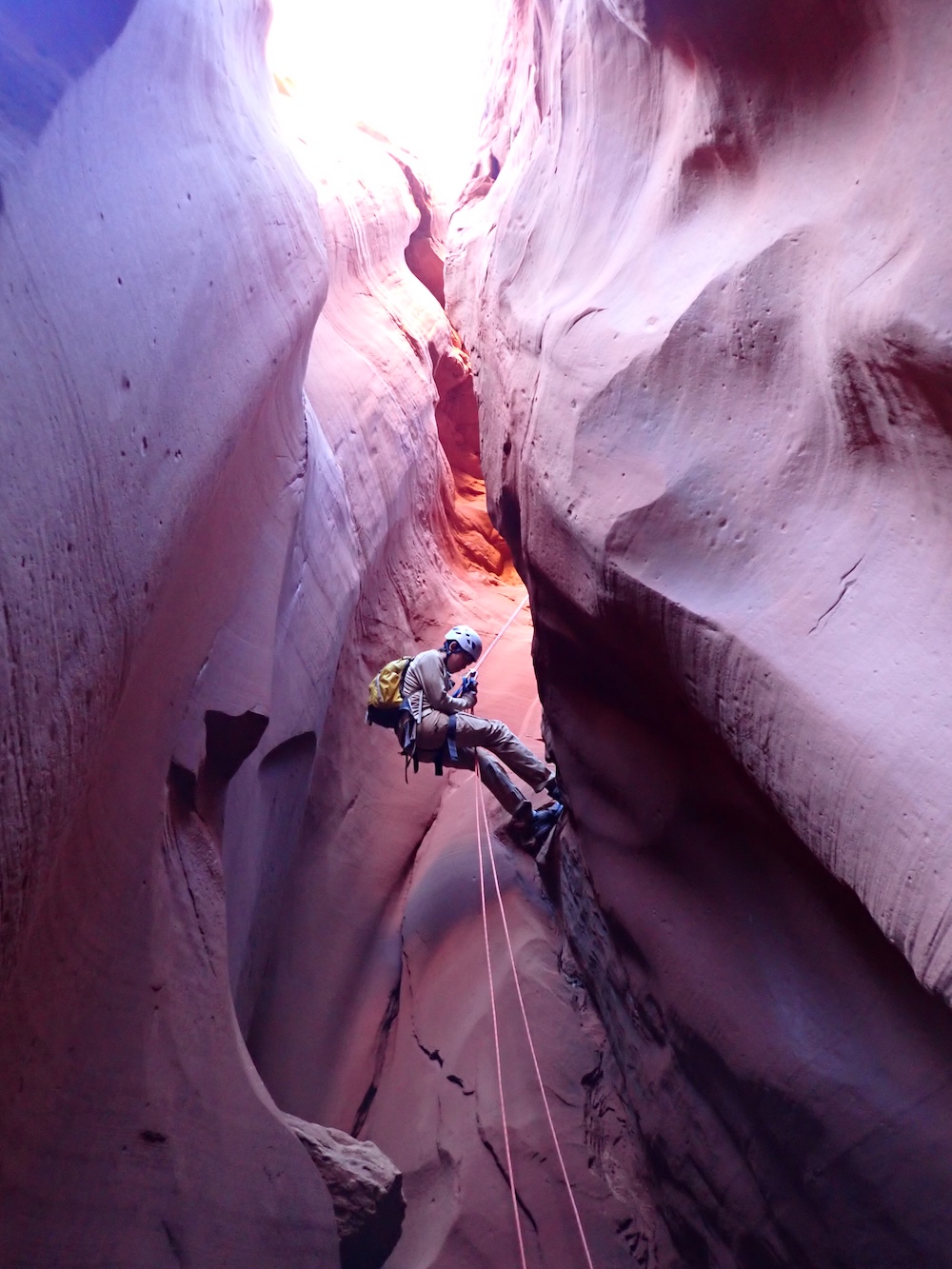 It’s tough navigating deep water, ground that never quite stays solid, and bushes so thick you learn the true definition of bushwhacking. Hint: the bushes whack you, not the other way around. But, despite the challenges, it’s joyous fun. Everything we’ve been learning since the beginning of semester we are now putting to use, and it’s truly gratifying to witness our success.
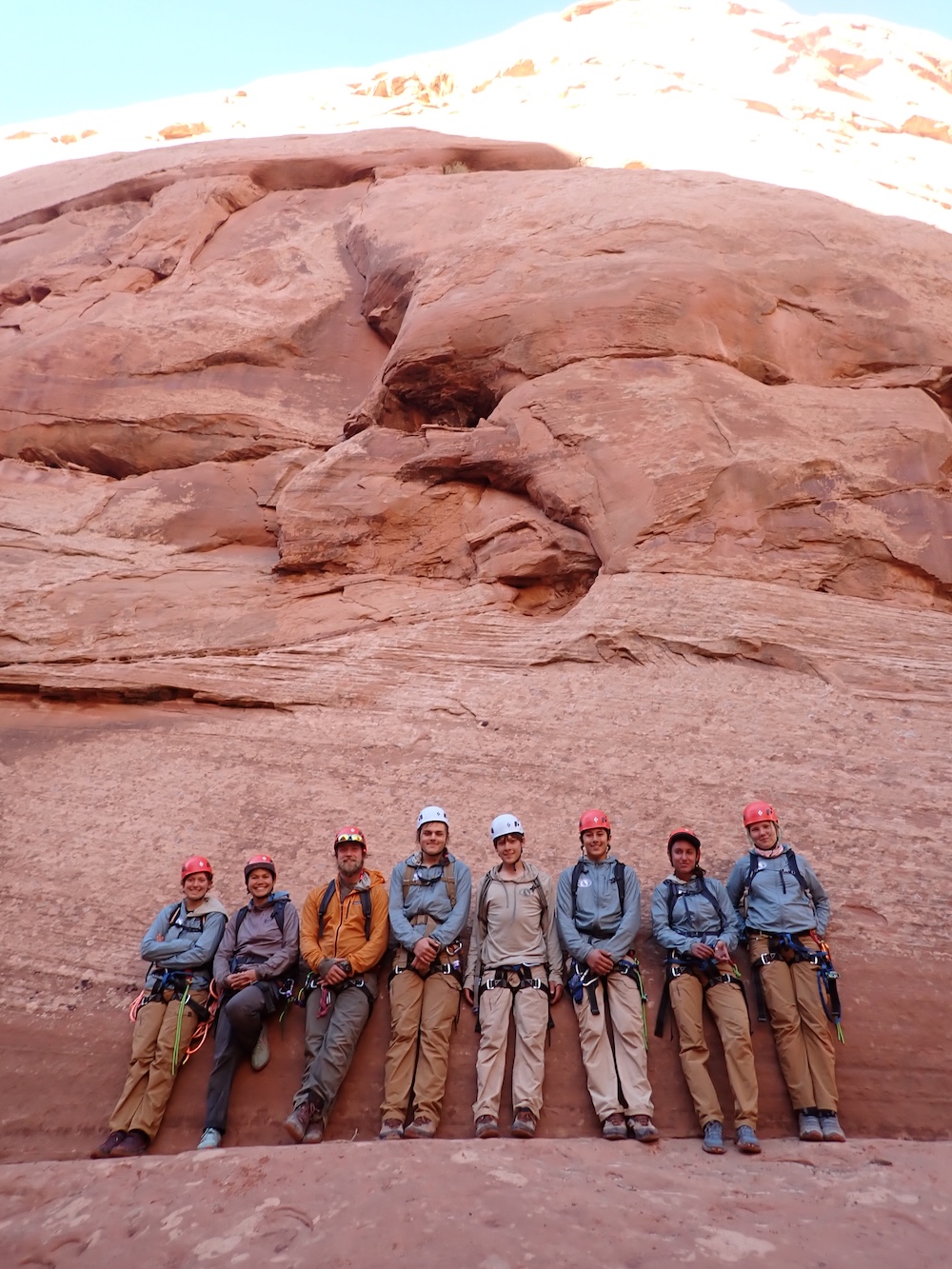 Never once do we feel alone, because we have each other and each person knows how to do their part in the group. On ISGE, many of us are moving through the world, for the first time, like adults. Keane and Caleb follow close behind, in case of emergency, though we rarely see them. This journey is ours and ours alone, and we are all rising to the challenge. We spend three nights in our groups of six, growing more comfortable in our environment as time goes on. On the fourth day, our groups come together to share a final night on the river and swap stories of our very similar but also vastly different experiences. Come morning, we pack up camp together and hike out into Hanksville to meet Gracie with the van at noon.
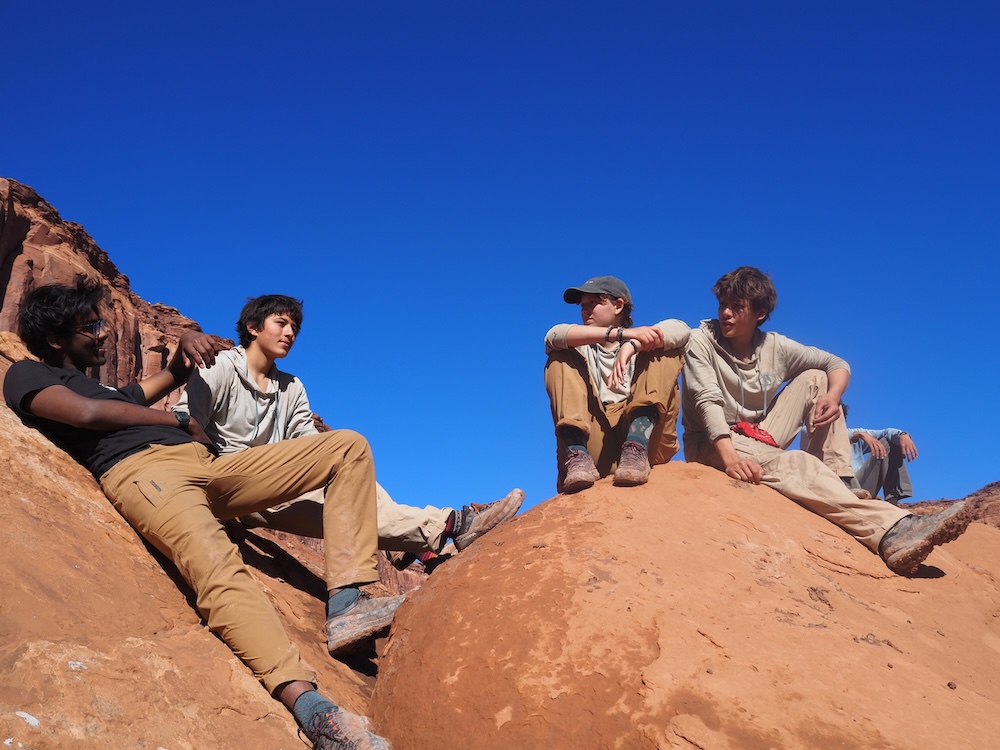
Adarsh, Lucas, Noah and Finn
It’s a bizarre feeling to walk back into civilization in a group of twelve, covered in mud from head to foot and wearing matching clothes and heavy packs. While we wait for the van, we tour a sculpture garden that also looks like it waltzed its way out of the 60’s and staked its claim on the 21st century: colorful, magical, full of inspirational sayings, and so very… Kroka.
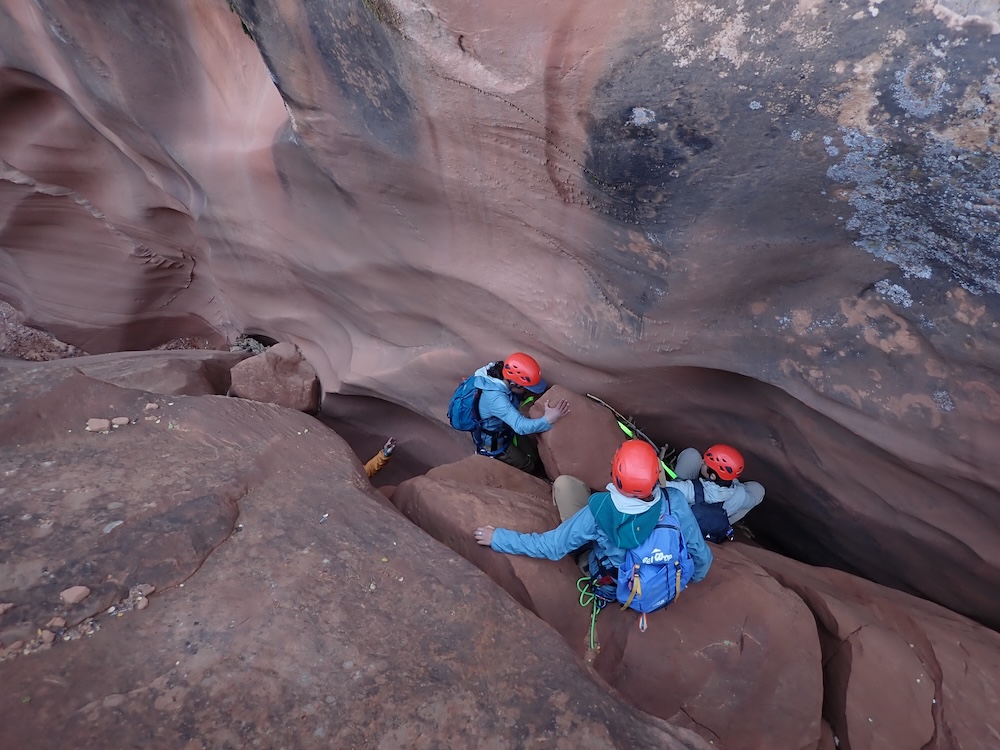 Back at Green River State Park, we debrief our adventures and come up with a list of “hot takes” about the canyons which I have seen fit to list here:
1) Hot Take: “It’s okay to take 20 pounds of pretty rocks home with you in your backpack.”
2) Hot Take: “The canyons make me scared for my life.”
3) Hot Take: “The water treatment pool chlorine isn’t that bad”
4) Hot Take: “It’s okay to hunt the rattlesnake!”
5) Hot Take: “Scorpions aren’t that bad.”
6) Hot Take: “We don’t need the tent bodies.”
7) Hot Take: “You can live off of only pasta.”
Suffice it to say, these are obviously the most important lessons we learned. In all seriousness, as is with every expedition, we have all come out as stronger individuals as well as a more cohesive whole.
One thing is for certain: adventures are better both on the river and in life when we’re all in it together.
Now, I sit on the dock by the Green River as preparations for Desolation Canyon are being finalized. I don’t know where the river of time will lead us next, but as always I stand ready to pen our story along the way.
Until next time, I bid you my best wishes and farewell.
Your dutiful scribe,
Zoe.